Introduction
Understanding Production Planning in Jewellery Manufacturing
Production planning in jewellery manufacturing refers to the
process of organizing and managing resources such as raw materials, machinery,
workforce, and timelines to ensure that jewellery products are manufactured
efficiently and delivered on time while maintaining quality standards and cost
control. In a jewellery business where production involves multiple stages such
as design, casting, polishing, stone setting, and finishing, effective planning
is essential to coordinate these processes and avoid delays or bottlenecks that
can impact delivery timelines and customer satisfaction. Traditional production
planning methods often rely on manual coordination and experience-based
decision-making, which can lead to inefficiencies, miscommunication, and suboptimal
resource utilization, making it necessary for businesses to adopt advanced
technologies such as artificial intelligence to enhance planning accuracy and
operational efficiency.
Role of Karigar Allocation in Jewellery Production
Karigar allocation is a critical component of jewellery
production as skilled artisans are responsible for executing various stages of
manufacturing, and their expertise directly impacts product quality, production
speed, and overall business performance. Efficient allocation of karigars
involves assigning the right tasks to the right individuals based on their
skills, experience, workload, and availability, ensuring that production
processes are carried out smoothly and efficiently without overburdening or
underutilizing resources. In traditional setups, karigar allocation is often
managed manually, which can result in imbalances such as uneven workload
distribution, delays in task completion, and reduced productivity, highlighting
the need for intelligent systems that can optimize allocation and improve
overall production efficiency.
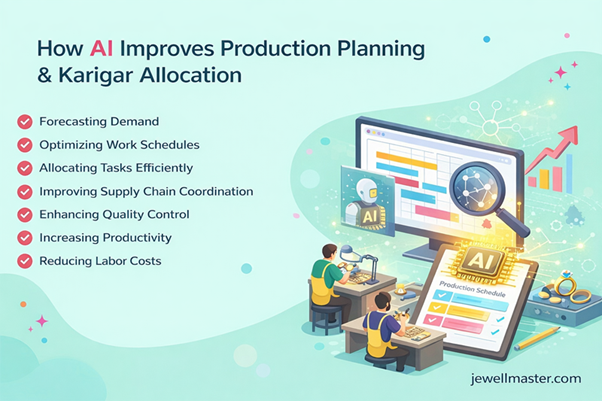
How AI Enhances Production Planning
Artificial intelligence enhances production planning by
analyzing large volumes of data related to production processes, resource
availability, order requirements, and historical performance to generate
optimized production schedules that improve efficiency and reduce delays. AI
systems use predictive analytics to forecast production demand, identify
potential bottlenecks, and recommend optimal resource allocation strategies
that ensure smooth workflow and timely completion of orders. For example, AI can
analyze past production data to determine the average time required for each
manufacturing stage and use this information to create realistic production
schedules that minimize delays and improve overall efficiency, enabling
businesses to meet customer expectations and maintain high levels of
productivity.
How AI Optimizes Karigar Allocation
AI optimizes karigar allocation by evaluating multiple
factors such as skill levels, past performance, workload, availability, and
task complexity to assign the most suitable karigar for each task, ensuring
efficient utilization of resources and improved production outcomes. By using
machine learning algorithms, AI systems can identify patterns in karigar performance and recommend allocation strategies that maximize productivity and
quality while minimizing delays and errors. For instance, if a particular karigar
has demonstrated expertise in intricate stone setting tasks, the system can
prioritize assigning similar tasks to that individual, ensuring that work is
completed efficiently and to a high standard, while also balancing workload
across the team to prevent burnout and maintain consistent performance.
Key Benefits of AI in Production & Workforce Management
AI provides significant benefits in production planning and
workforce management by improving efficiency, reducing operational costs, and
enhancing overall productivity through intelligent automation and data-driven
decision making that ensures optimal utilization of resources and timely
completion of tasks. By minimizing manual intervention and reducing errors, AI
enables businesses to streamline operations, improve coordination, and achieve
better outcomes, while also providing real-time insights into production
performance and workforce utilization that support continuous improvement and
strategic planning. Additionally, AI enhances transparency and accountability
by providing detailed tracking and reporting of production activities and
workforce performance, enabling businesses to identify areas for improvement
and implement effective solutions.
Role of Jewell Master in AI-Driven Production Planning
Jewell Master plays a crucial role in enabling AI-driven
production planning and karigar allocation by providing a centralized platform
that integrates production management, inventory tracking, and workforce
management into a single system that supports data-driven decision making and
operational efficiency. With features such as job work management, karigar
tracking, production status updates, and reporting, Jewell Master allows
businesses to monitor and manage production processes effectively, ensuring that
tasks are assigned and executed efficiently. By leveraging data collected
through these systems, businesses can implement AI-driven strategies that
optimize production planning and workforce allocation, improving efficiency,
reducing delays, and enhancing overall business performance.
Challenges Solved by AI in Jewellery Manufacturing
Jewellery manufacturers often face challenges such as
production delays, inefficient resource utilization, lack of coordination, and
difficulty in managing workforce allocation, all of which can impact
productivity and profitability. AI addresses these challenges by providing
intelligent solutions that optimize planning and allocation processes, ensuring
that resources are used efficiently and tasks are completed on time. By
reducing reliance on manual processes and improving decision-making accuracy, AI helps businesses overcome operational inefficiencies, enhance productivity, and
maintain a competitive edge in the market.
AI vs Traditional Production Planning Methods
|
Aspect |
Traditional
Planning |
AI-Based
Planning |
|
Resource
Allocation |
Manual |
Automated
& optimized |
|
Efficiency |
Moderate |
High
efficiency |
|
Decision
Making |
Experience-based |
Data-driven |
|
Flexibility |
Limited |
Highly
flexible |
|
Productivity |
Variable |
Consistent
& improved |
Key Features of AI Production Planning Systems
- Automated
production scheduling and planning
- Intelligent
karigar allocation based on skills and workload
- Real-time
tracking of production progress
- Predictive
analytics for demand and resource planning
- Integration
with inventory and order management systems
- Performance
monitoring and reporting
- Improved
coordination and workflow management
Future of AI in Jewellery Manufacturing
The future of jewellery manufacturing is increasingly driven
by artificial intelligence and automation, where businesses will rely on
intelligent systems to optimize production processes, enhance workforce
management, and improve operational efficiency in a competitive market
environment. As AI technology continues to evolve, it will become more advanced
and capable of handling complex production scenarios, enabling businesses to
achieve higher levels of productivity, quality, and profitability. With platforms
like Jewell Master supporting digital transformation and data integration,
jewellery manufacturers can seamlessly adopt AI-driven solutions and stay ahead
of market trends, ensuring long-term growth and success in the industry.
Conclusion
Artificial intelligence is transforming jewellery manufacturing by improving production planning and karigar allocation through data-driven insights and intelligent automation that enhance efficiency, reduce delays, and optimize resource utilization. By integrating AI with Jewell Master, jewellery businesses can streamline operations, improve productivity, and achieve better outcomes, ensuring sustainable growth and competitive advantage in a rapidly evolving market. As the industry continues to advance, adopting AI-driven production strategies will be essential for businesses looking to stay ahead and deliver high-quality products efficiently.
