Introduction
Understanding the Connection Between Manufacturing, Inventory, and Billing
Jewellery manufacturing begins with the issuance of raw
metals and gemstones from inventory. These materials are then transformed into
finished jewellery through processes such as casting, stone setting, polishing,
and finishing. Once the product is completed, it returns to inventory as a
finished good ready for sale. When the jewellery item is sold to a customer,
the billing system must reflect the correct product cost, metal weight, making
charges, and applicable taxes. Because these three functions are closely
connected, any mismatch between them can create operational problems. For
example, if manufacturing data is not properly linked with inventory records,
businesses may not know the exact amount of metal used for production.
Similarly, if billing systems are not connected to production data, product
pricing may be calculated incorrectly. Integrated systems eliminate these
issues by ensuring that data flows seamlessly between manufacturing, inventory,
and billing modules.
Challenges of Managing Manufacturing and Billing Separately
Many jewellery businesses still rely on separate systems for
manufacturing management and billing operations. Production teams may maintain
manual registers to track metal issued to karigars, while billing departments
use accounting software to generate invoices. Because these systems operate
independently, data must be transferred manually between departments. This
process increases the risk of errors and inconsistencies. For instance, the
final jewellery weight recorded in the production register may not match the
weight entered in the billing system. Such discrepancies can affect pricing
accuracy and inventory valuation. In addition, separate systems make it
difficult to generate real-time reports that show how manufacturing activities
affect stock levels and revenue. As jewellery businesses expand, these
inefficiencies can significantly impact operational performance.
Why Integrated Systems Are Essential for Jewellery Businesses
Integrated systems provide a centralized platform where
manufacturing, inventory, and billing activities are managed within a single
digital environment. This integration ensures that every production activity
automatically updates inventory records and cost calculations. When raw metals
are issued for manufacturing, the system records the inventory deduction
instantly. When the finished jewellery piece is completed, the system updates
stock levels with the new product. Finally, when the product is sold, the
billing module retrieves accurate data regarding metal weight, making charges,
and product pricing. By connecting these processes, integrated systems
eliminate manual data entry and ensure that business records remain consistent
across departments.
Key Manufacturing Data Integrated with Inventory and Billing
For successful integration, jewellery ERP systems must
connect production data with inventory and billing modules to ensure accurate
cost and stock management.
• Raw metal issued from inventory for production
• Jewellery design specifications and Bill of Materials
• Work in progress tracking during manufacturing stages
• Labour charges and making cost calculations
• Finished jewellery weight and purity after production
• Product entry into showroom inventory
• Customer billing with accurate metal and labour charges
By linking these elements within a unified system, jewellery
businesses can maintain precise control over production costs and inventory
levels.
How Manufacturing Integration Improves Inventory Accuracy
Inventory accuracy is critical in jewellery businesses
because precious metals represent high-value assets. When manufacturing systems
are integrated with inventory management, every material movement is recorded
automatically. For example, when gold is issued to a karigar for production,
the inventory module immediately reflects the reduction in raw metal stock. As
the jewellery piece moves through the manufacturing process, the system tracks
the metal weight and production status. Once the finished product is returned,
inventory records are updated with the new jewellery item. This automated
process ensures that inventory data remains accurate without requiring manual
reconciliation. Over time, integrated inventory systems help businesses
maintain better control over their precious metal assets.
Typical Workflow of Integrated Manufacturing, Inventory, and Billing
A structured workflow ensures that production activities are
synchronized with inventory updates and billing operations.
|
Process
Stage |
Purpose |
|
Raw Material
Issue |
Deduct metal
from inventory for production |
|
Production
Tracking |
Monitor work
in progress and labour activities |
|
Finished
Product Entry |
Add completed
jewellery piece to inventory |
|
Quality
Inspection |
Verify
product before showroom entry |
|
Sales Order
Creation |
Record
customer purchase request |
|
Billing
Generation |
Generate
invoice with accurate product data |
|
Inventory
Update |
Reduce stock
after sale |
This integrated workflow ensures that jewellery businesses
maintain accurate records throughout the product lifecycle.
Benefits of Integrated Manufacturing Management
Integrating manufacturing processes with inventory and
billing provides several operational advantages for jewellery businesses.
First, it eliminates duplicate data entry because information entered in one
module automatically updates related systems. Second, integration improves
financial accuracy because production costs are directly linked to product
pricing. Third, businesses gain real-time visibility into inventory levels and
manufacturing activities. Managers can quickly determine how much metal is currently
under production and how many finished jewellery pieces are available for sale.
Integration also simplifies reporting because all operational data is stored
within a centralized database. This enables jewellery businesses to generate
detailed reports regarding production efficiency, inventory usage, and sales
performance.
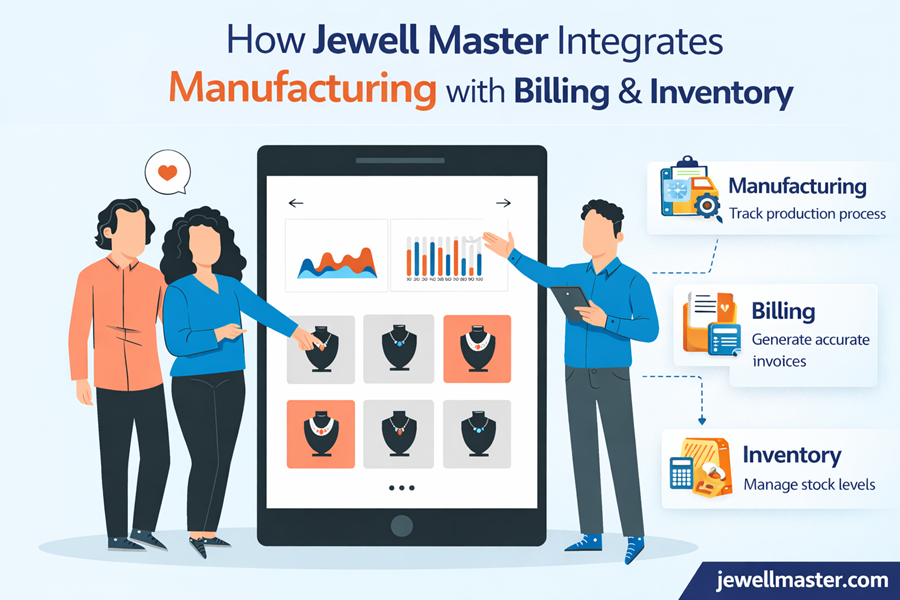
How Jewell Master Integrates Manufacturing with Billing and Inventory
Jewell Master ERP provides a fully integrated platform that
connects jewellery manufacturing operations with inventory management and
billing systems. When raw metals or gemstones are issued for production, the
system records the transaction and updates inventory levels automatically. As
production progresses, Jewell Master tracks work in progress and records labour
charges associated with each jewellery piece. Once the product is completed, it
is automatically added to the finished goods inventory. When a customer
purchase occurs, the billing module retrieves accurate data regarding metal
weight, making charges, and applicable taxes. This ensures that invoices
reflect precise product information without requiring manual calculations. By
integrating these processes, Jewell Master enables jewellery businesses to
maintain complete operational transparency.
Improving Business Efficiency Through Automation
Automation plays a significant role in improving efficiency
across jewellery manufacturing operations. When manufacturing, inventory, and
billing systems operate together within a single platform, businesses can
reduce administrative workload and minimize human errors. Automated systems
also provide real-time dashboards that allow managers to monitor production
progress, inventory availability, and sales performance simultaneously. These
insights help businesses make faster decisions regarding production planning,
stock replenishment, and pricing strategies. Over time, automation helps
jewellery businesses build more organized and scalable operations.
Conclusion
Integrating manufacturing with inventory and billing is essential for jewellery businesses that want to maintain accurate records and efficient operations. When these systems operate separately, businesses often face data inconsistencies, inventory discrepancies, and pricing errors. Modern ERP platforms such as Jewell Master provide a comprehensive solution by connecting manufacturing workflows with inventory management and billing modules. This integration ensures that every stage of jewellery production is automatically reflected in stock records and customer invoices. By adopting integrated systems, jewellery businesses can improve operational transparency, reduce administrative workload, and maintain accurate financial records. Ultimately, this streamlined approach helps jewellery manufacturers and retailers operate more efficiently in an increasingly competitive market.
