Introduction
Understanding RPA in Jewellery Billing & Accounting
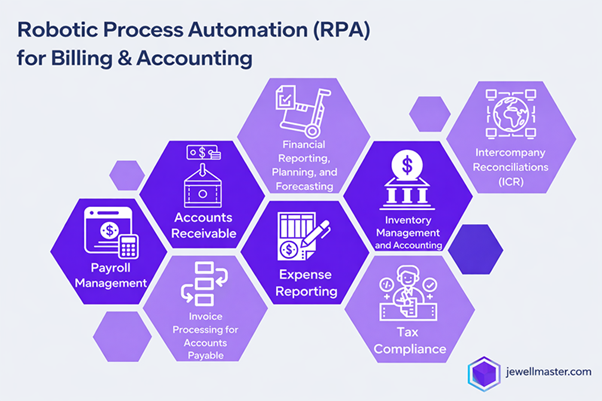
Robotic Process Automation in jewellery billing and
accounting refers to the use of software bots that automate routine, rule-based
tasks such as invoice generation, GST calculations, ledger updates, payment
reconciliation, and report creation, enabling businesses to streamline
financial operations and eliminate manual intervention in repetitive processes.
In a jewellery business where transactions involve complex calculations related
to gold weight, purity, making charges, wastage, and taxes, manual billing and
accounting processes can be time-consuming and prone to errors, which can lead
to financial discrepancies, compliance issues, and inefficiencies in
operations. RPA addresses these challenges by executing tasks with high
precision and consistency, ensuring that financial records are accurate,
up-to-date, and compliant with regulatory requirements, while also freeing up
staff to focus on higher-value activities such as customer service and business
strategy.
Why Automation is Critical in Jewellery Financial Operations
Automation is critical in jewellery financial operations
because the industry deals with high-value transactions, complex pricing structures, and strict compliance requirements that demand accuracy, speed, and
reliability in billing and accounting processes. Traditional manual systems
often result in delays, calculation errors, and inconsistencies that can impact
customer trust, regulatory compliance, and overall business performance, making
it essential for businesses to adopt automated solutions that improve
efficiency and reduce risks. RPA enables jewellery businesses to handle large
volumes of transactions efficiently, ensure accurate tax calculations, and
maintain consistent financial records, thereby improving operational
efficiency, reducing costs, and enhancing customer satisfaction through faster
and error-free billing processes.
How RPA Works in Billing & Accounting Systems
RPA works in billing and accounting systems by mimicking
human actions within software applications to perform tasks such as data entry,
invoice generation, transaction processing, and report creation, using
predefined rules and workflows that ensure consistency and accuracy in
execution. These software bots can interact with multiple systems, extract and
process data, validate information, and update records automatically,
eliminating the need for manual intervention and reducing the risk of errors.
For example, when a jewellery sale is completed, an RPA bot can automatically
generate the invoice, calculate GST based on applicable rates, update inventory
records, record the transaction in the ledger, and generate financial reports,
all within seconds, ensuring seamless and efficient processing of financial
operations.
Key Benefits of RPA in Jewellery Retail
RPA provides numerous benefits to jewellery retailers by improving efficiency, accuracy, and scalability in billing and accounting processes, enabling businesses to handle increasing transaction volumes without additional manpower or operational costs. By automating repetitive tasks, RPA reduces processing time, eliminates human errors, and ensures compliance with financial regulations, while also improving transparency and auditability through consistent and accurate record-keeping. Additionally, RPA enhances customer experience by enabling faster billing and reducing waiting times, while also providing real-time financial insights that help businesses make informed decisions and improve overall performance.
Role of Jewell Master in RPA Implementation
Jewell Master plays a crucial role in enabling RPA in
jewellery billing and accounting by providing an integrated platform that
supports automation, real-time data processing, and seamless workflow
management across all financial operations. With features such as automated
billing, GST compliance, ledger management, and reporting, Jewell Master
reduces the need for manual intervention and ensures that financial processes
are executed accurately and efficiently. By integrating RPA capabilities with
inventory and customer management systems, Jewell Master enables end-to-end
automation of business operations, ensuring that all transactions are recorded
consistently and transparently, while also providing valuable insights that
support better decision-making and business growth.
Challenges Solved by RPA in Jewellery Business
Jewellery businesses often face challenges such as manual
errors in billing, delayed financial processing, lack of standardization, and
difficulty in maintaining compliance with tax regulations, all of which can
impact operational efficiency and profitability. RPA addresses these challenges
by automating routine tasks, ensuring consistency and accuracy in financial
operations, and enabling real-time processing of transactions and data, which
improves efficiency and reduces risks. By eliminating repetitive manual work
and providing reliable automation, RPA helps businesses enhance productivity,
reduce costs, and maintain better control over their financial processes,
ensuring smooth and efficient operations.
RPA vs Traditional Billing & Accounting Methods
|
Aspect |
Traditional
Methods |
RPA-Based
Automation |
|
Processing
Speed |
Slow |
Instant |
|
Accuracy |
Error-prone |
High accuracy |
|
Cost
Efficiency |
High
operational cost |
Reduced cost |
|
Scalability |
Limited |
Highly
scalable |
|
Compliance |
Manual checks |
Automated
compliance |
Key Features of RPA in Jewellery Systems
- Automated invoice generation and billing
- Real-time
GST calculation and compliance
- Ledger
and accounting automation
- Payment
reconciliation and tracking
- Automated
financial reporting and dashboards
- Integration
with inventory and CRM systems
- Reduced
manual intervention and errors
Future of RPA in Jewellery Retail
The future of jewellery retail is increasingly driven by
automation and intelligent systems, where RPA will play a central role in
streamlining financial operations, improving efficiency, and enabling
businesses to scale effectively in a competitive market environment. As
technology continues to evolve, RPA will become more advanced and integrated
with artificial intelligence and analytics, enabling smarter automation that
can handle complex tasks and provide deeper insights into business performance.
With platforms like Jewell Master supporting automation and digital
transformation, jewellery businesses can adopt RPA solutions seamlessly and
stay ahead of market trends, ensuring long-term growth and success.
Conclusion
Robotic Process Automation is transforming jewellery billing and accounting by automating repetitive tasks, improving accuracy, and enhancing operational efficiency through intelligent software bots. By integrating RPA with Jewell Master, jewellery businesses can streamline financial operations, reduce costs, and improve customer experience, ensuring efficient and reliable business processes. As the industry continues to evolve, adopting RPA will be essential for businesses looking to achieve operational excellence and maintain a competitive edge in the market.
