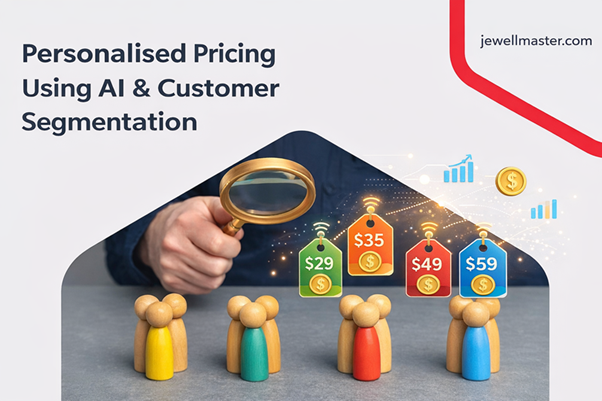
Introduction
Understanding Personalised Pricing in Jewellery Retail
Personalised pricing in jewellery retail refers to the
practice of adjusting product pricing, offers, and discounts based on
individual customer profiles, purchasing behaviour, demographics, and
engagement patterns, allowing businesses to deliver tailored pricing strategies
that align with customer expectations and willingness to pay. In an industry
where products are high-value and purchase decisions are influenced by multiple
factors such as occasion, budget, design preference, and emotional value, traditional
fixed pricing models often fail to capture the full potential of each customer
interaction, resulting in missed revenue opportunities and lower conversion
rates. By leveraging artificial intelligence, jewellery businesses can analyze
vast amounts of customer and transactional data to identify patterns and create
personalized pricing strategies that optimize both sales and profitability,
ensuring that each customer receives the most relevant and attractive pricing
without compromising business margins.
Role of Customer Segmentation in Pricing Strategy
Customer segmentation plays a critical role in personalised
pricing by grouping customers into distinct categories based on shared
characteristics such as purchase history, spending capacity, frequency of
transactions, product preferences, and behavioural patterns, enabling
businesses to design targeted pricing strategies that cater to each segment
effectively. In jewellery retail, segmentation can include categories such as
high-value buyers, occasional buyers, bridal customers, festive shoppers, and discount-sensitive
customers, each requiring a different approach to pricing and promotions. By
understanding the unique needs and preferences of each segment, businesses can
offer tailored pricing strategies such as exclusive discounts, loyalty
benefits, premium pricing for luxury segments, and special offers for
price-sensitive customers, ensuring that pricing decisions are aligned with
customer expectations and market dynamics, ultimately leading to improved
customer satisfaction and increased revenue.
How AI Enables Personalised Pricing
Artificial intelligence enables personalised pricing by
analyzing large volumes of data from multiple sources including sales
transactions, customer profiles, browsing behaviour, market trends, and
competitor pricing to generate insights that guide pricing decisions in real
time. AI algorithms use techniques such as predictive analytics to forecast
customer behaviour, machine learning models to identify patterns in purchasing
decisions, and dynamic pricing mechanisms to adjust prices based on demand, customer
segmentation, and market conditions. For example, AI can identify customers who
are likely to purchase premium jewellery and offer them exclusive collections
at higher price points, while also identifying price-sensitive customers and
providing targeted discounts to encourage conversion, ensuring that pricing
strategies are optimized for both customer satisfaction and business
profitability.
Key Benefits of AI-Based Personalised Pricing
AI-based personalised pricing offers significant benefits to
jewellery retailers by improving revenue optimization, enhancing customer
experience, and increasing conversion rates through tailored pricing strategies
that align with individual customer preferences and behaviour. By offering the
right price to the right customer at the right time, businesses can maximize
sales opportunities, reduce dependency on blanket discounts, and improve profit
margins while maintaining customer satisfaction. Additionally, personalised
pricing helps in building stronger customer relationships by providing relevant
and meaningful offers that resonate with customer needs, leading to increased
loyalty, repeat purchases, and long-term business growth.
Role of Jewell Master in Personalised Pricing Implementation
Jewell Master provides a powerful platform that enables
jewellery businesses to implement personalised pricing strategies by capturing
and analyzing customer data, sales trends, and transaction history in a
centralized system that supports data-driven decision-making. With features
such as customer management, advanced reporting, and real-time analytics,
Jewell Master allows businesses to segment customers effectively, track
purchasing behavior, and design targeted pricing strategies that enhance sales and
profitability. By integrating inventory, billing, and customer data, Jewell
Master ensures that pricing decisions are aligned with stock availability and
market demand, enabling businesses to implement personalised pricing seamlessly
and efficiently without the need for complex external systems.
Challenges Solved by AI in Pricing Strategy
Jewellery retailers often face challenges such as uniform
pricing strategies, inefficient discounting, lack of customer insights, and
difficulty in balancing profitability with customer satisfaction, all of which
can limit business growth and competitiveness. AI addresses these challenges by
providing data-driven insights that enable businesses to understand customer
behaviour, optimize pricing strategies, and make informed decisions that
improve both revenue and customer experience. By eliminating guesswork and
enabling real-time pricing adjustments, AI helps businesses achieve better
pricing accuracy, reduce unnecessary discounts, and maintain competitive
advantage in a dynamic market environment.
AI-Based Pricing vs Traditional Pricing Models
|
Aspect |
Traditional
Pricing |
AI-Based
Personalised Pricing |
|
Pricing
Strategy |
Fixed |
Dynamic &
personalized |
|
Customer
Insight |
Limited |
Data-driven |
|
Profit
Optimization |
Moderate |
High
optimization |
|
Flexibility |
Low |
Highly
flexible |
|
Customer
Experience |
Generic |
Personalized |
Key Features of Personalised Pricing Systems
- AI-driven
customer segmentation and analysis
- Dynamic
pricing based on demand and behaviour
- Personalized
discounts and offers
- Real-time pricing adjustments
- Integration
with sales and inventory systems
- Predictive
analytics for pricing optimization
- Enhanced
customer engagement and retention
Future of Personalised Pricing in Jewellery Retail
The future of jewellery retail is increasingly focused on
personalization and data-driven decision-making, where AI-powered pricing
strategies will play a crucial role in enhancing customer experience, improving
profitability, and driving business growth in a competitive market environment.
As technology continues to evolve, personalised pricing systems will become
more advanced and capable of analyzing complex data patterns to deliver highly
accurate and effective pricing strategies that align with customer expectations
and market trends. With platforms like Jewell Master supporting advanced
analytics and data integration, jewellery businesses can seamlessly adopt
personalised pricing strategies and stay ahead of the competition, ensuring
long-term success and sustainability in the industry.
Conclusion
Personalised pricing using AI and customer segmentation is transforming jewellery retail by enabling businesses to deliver tailored pricing strategies that improve customer satisfaction, increase conversions, and maximize profitability through data-driven insights and intelligent automation. By leveraging AI and integrating it with Jewell Master, jewellery businesses can optimize their pricing strategies, enhance customer relationships, and achieve sustainable growth in a competitive market. As the industry continues to evolve, adopting personalised pricing will be essential for businesses looking to stay ahead and deliver exceptional value to their customers.
