Introduction
Understanding IoT in Jewellery Inventory Management
IoT in jewellery inventory management refers to the use of
connected devices such as RFID tags, smart sensors, barcode scanners, and
IoT-enabled tracking systems that continuously monitor and transmit data about
stock movement, location, and status in real time, allowing jewellery businesses to maintain complete visibility and control over their inventory
without relying on manual tracking methods. In a jewellery business where
products are high-value and often small in size, maintaining accurate inventory
records is critical to prevent losses, ensure availability, and support
efficient operations, and IoT provides a reliable solution by automating data
capture and eliminating human errors that commonly occur in manual processes.
These systems work by connecting physical inventory items to digital platforms,
enabling businesses to track each item’s journey from procurement to sale,
ensuring transparency, accuracy, and efficiency across all inventory-related
operations.
Why Real-Time Stock Monitoring is Critical in Jewellery Business
Real-time stock monitoring is essential in jewellery businesses because inventory represents a significant portion of the company’s
capital investment, and any discrepancies or inaccuracies can lead to financial
losses, operational inefficiencies, and reduced customer satisfaction due to
stockouts or incorrect availability information. Traditional inventory
management systems often rely on periodic stock checks and manual updates,
which can result in delays, errors, and lack of visibility into real-time stock
status, making it difficult for businesses to respond quickly to changes in
demand or detect potential issues such as theft or misplacement of items.
IoT-based real-time monitoring addresses these challenges by providing
continuous updates on stock levels and movements, enabling businesses to make
informed decisions, optimize inventory levels, and ensure that products are
always available when needed, thereby improving operational efficiency and
customer experience.
How IoT Devices Work for Stock Monitoring
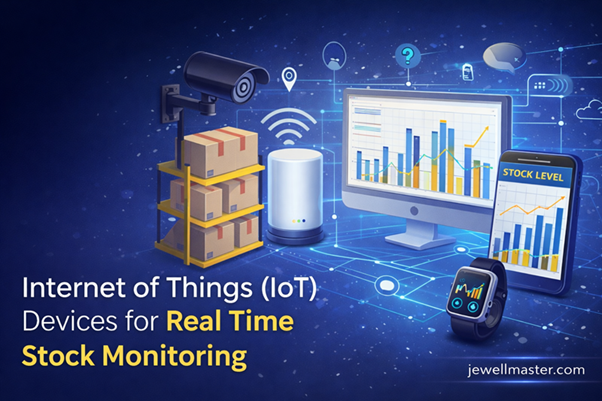
IoT devices for stock monitoring operate by attaching smart
tags such as RFID or IoT-enabled sensors to jewellery items or storage units,
which then communicate with a centralized system through wireless networks to
transmit data about the item’s location, movement, and status in real time.
These devices can automatically update inventory records whenever an item is
moved, sold, or transferred, eliminating the need for manual data entry and
reducing the risk of errors and discrepancies. For example, when a jewellery
item is taken from the display counter for a customer trial, the system can
instantly record its movement and update its status, ensuring that inventory
records remain accurate at all times, while also providing alerts in case of
unauthorized movement or potential theft, thereby enhancing security and
operational control.
Key Benefits of IoT in Jewellery Retail
IoT technology provides numerous benefits to jewellery retailers by improving inventory accuracy, reducing losses, and enhancing
operational efficiency through automated and real-time data tracking that
enables better decision-making and resource management. By providing complete
visibility into stock levels and movements, IoT helps businesses reduce dead
stock, prevent overstocking, and ensure that high-demand products are always
available, while also improving security by detecting unauthorized movements and
preventing theft. Additionally, IoT reduces the time and effort required for
inventory management by automating routine tasks, allowing staff to focus on
customer service and sales activities, ultimately leading to improved
productivity, profitability, and customer satisfaction.
Role of Jewell Master in IoT Integration
Jewell Master plays a crucial role in enabling IoT-based
inventory management by providing a centralized platform that integrates data
from IoT devices with inventory, billing, and reporting systems, ensuring that
all stock-related information is accurately recorded and easily accessible for
analysis and decision-making. By supporting integration with RFID systems, barcode scanners, and other IoT devices, Jewell Master allows businesses to
automate inventory tracking, monitor stock movements in real time, and generate
detailed reports that provide insights into inventory performance and trends.
This integration enhances operational efficiency, reduces manual errors, and
ensures that businesses have complete control over their inventory, enabling
them to optimize stock levels, improve security, and deliver better customer
service.
Challenges Solved by IoT in Inventory Management
Jewellery retailers often face challenges such as inventory
discrepancies, theft, manual errors, lack of real-time visibility, and
inefficient stock management processes, all of which can negatively impact
business performance and profitability. IoT addresses these challenges by
providing automated and real-time tracking of inventory, ensuring accurate and
up-to-date information about stock levels and movements, and enabling
businesses to detect and respond to issues quickly and effectively. By reducing
reliance on manual processes and improving data accuracy, IoT helps businesses
enhance operational efficiency, reduce losses, and maintain better control over
their inventory, ensuring smooth and efficient business operations.
IoT vs Traditional Inventory Tracking Methods
|
Aspect |
Traditional
Methods |
IoT-Based
Monitoring |
|
Data Updates |
Manual |
Automatic
& real-time |
|
Accuracy |
Moderate |
High accuracy |
|
Visibility |
Limited |
Full
visibility |
|
Theft
Detection |
Delayed |
Instant
alerts |
|
Efficiency |
Low |
High
efficiency |
Key Features of IoT Stock Monitoring Systems
- Real-time
tracking of inventory items
- RFID
and smart sensor integration
- Automated
stock updates and alerts
- Location-based
tracking of products
- Integration
with inventory and billing systems
- Enhanced
security and theft detection
- Data-driven
insights and reporting
Future of IoT in Jewellery Retail
The future of jewellery retail is increasingly driven by
connected technologies such as IoT, where businesses will rely on smart devices
and real-time data to optimize operations, enhance security, and improve
customer experiences in a competitive market environment. As IoT technology
continues to evolve, it will become more advanced, affordable, and accessible,
enabling jewellery businesses of all sizes to adopt real-time stock monitoring
and automation solutions that improve efficiency and profitability. With
platforms like Jewell Master supporting IoT integration and data management,
businesses can seamlessly transition to smart inventory systems that provide
complete visibility, control, and insights, ensuring long-term growth and
success in the jewellery industry.
Conclusion
IoT devices are transforming jewellery inventory management by enabling real-time stock monitoring, improving accuracy, and enhancing operational efficiency through automated and connected systems. By integrating IoT with Jewell Master, jewellery businesses can achieve complete visibility and control over their inventory, reduce losses, and improve decision-making, ensuring sustainable growth and competitive advantage in a rapidly evolving market. As technology continues to advance, adopting IoT-based solutions will be essential for businesses looking to optimize their operations and deliver superior customer experiences.
