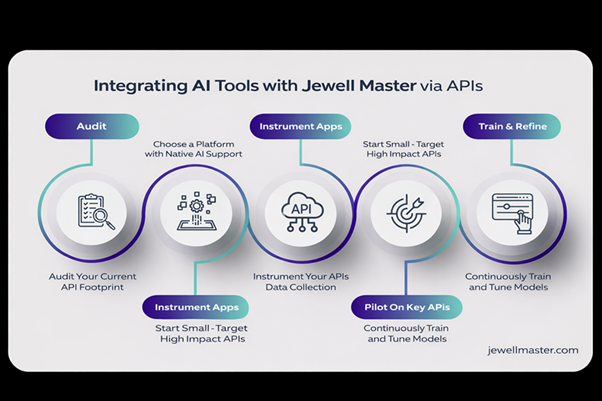
Introduction
Understanding API Integration in Jewellery Software
API integration in jewellery software refers to the process
of connecting different applications and systems through Application
Programming Interfaces, allowing them to communicate, share data, and perform
actions automatically without manual intervention, thereby creating a unified
and efficient digital ecosystem for business operations. In a jewellery
business environment where multiple systems such as billing, inventory management, CRM, marketing tools, and analytics platforms are used
simultaneously, APIs act as a bridge that ensures smooth data flow and
synchronization across these systems, eliminating data silos and improving
operational efficiency. By enabling seamless integration, APIs allow jewellery businesses to leverage advanced technologies such as artificial intelligence
and machine learning without replacing their existing systems, ensuring
flexibility, scalability, and cost-effectiveness in digital transformation
initiatives.
What are AI Tools in Jewellery Business
AI tools in jewellery business include a wide range of
applications such as demand forecasting systems, fraud detection engines,
recommendation systems, pricing optimization tools, customer segmentation
platforms, and marketing automation solutions that use artificial intelligence
to analyze data and generate actionable insights. These tools are designed to
enhance various aspects of business operations by automating processes,
improving accuracy, and enabling data-driven decision-making, which is essential
for staying competitive in a rapidly evolving market. By integrating AI tools
with core business systems like Jewell Master, jewellery businesses can unlock
new capabilities that improve efficiency, enhance customer experience, and
drive growth through intelligent automation and predictive analytics.
Why API-Based AI Integration is Important
API-based AI integration is important because it allows
jewellery businesses to adopt advanced technologies without disrupting their
existing workflows, ensuring that new capabilities can be added seamlessly to
current systems while maintaining operational continuity and data consistency.
Traditional approaches to technology adoption often require significant changes
to existing systems, leading to high costs, complexity, and potential
disruptions, whereas API integration provides a flexible and scalable solution
that enables businesses to connect AI tools with their existing platforms
easily. This approach not only reduces implementation time and cost but also
ensures that businesses can continuously evolve and adapt to new technologies,
enabling them to stay ahead of market trends and maintain a competitive
advantage.
How AI Tools Integrate with Jewell Master via APIs
AI tools integrate with Jewell Master via APIs by connecting
to its data layer and enabling real-time data exchange between systems,
allowing AI applications to access relevant data such as sales transactions,
inventory records, customer profiles, and operational metrics, which can be
used to generate insights and automate processes. These integrations enable AI
tools to perform tasks such as analyzing customer behaviour, predicting demand
trends, detecting fraud, and optimizing pricing strategies, while also updating
Jewell Master with the results of these analyses, ensuring that all systems
remain synchronized and up-to-date. For example, a demand forecasting AI tool
can access historical sales data from Jewell Master, generate predictions for
future demand, and send recommendations back to the system, enabling businesses
to optimize inventory planning and procurement strategies effectively.
Types of AI Integrations with Jewell Master
Jewellery businesses can integrate various types of AI tools
with Jewell Master through APIs to enhance different aspects of operations,
including predictive analytics for demand forecasting, machine learning models
for customer segmentation, AI-powered chatbots for customer support, fraud
detection systems for security, and marketing automation platforms for
personalized campaigns. Each of these integrations adds value by improving
efficiency, accuracy, and decision-making, enabling businesses to leverage the
full potential of artificial intelligence in their operations. By combining
multiple AI tools with Jewell Master, businesses can create a comprehensive and
intelligent ecosystem that supports growth, innovation, and operational
excellence.
Use Case: AI for Demand Forecasting via API
AI-based demand forecasting integration allows jewellery
businesses to analyze historical sales data, seasonal trends, and market
conditions to predict future demand accurately, enabling them to optimize
inventory levels and reduce the risk of stockouts or overstocking. By
connecting AI forecasting tools with Jewell Master through APIs, businesses can
automate the process of data analysis and receive real-time recommendations for
procurement and production planning, ensuring that inventory decisions are aligned
with market demand and customer preferences. This integration helps improve
efficiency, reduce costs, and enhance customer satisfaction by ensuring product
availability.
Use Case: AI for Fraud Detection Integration
AI-powered fraud detection systems can be integrated with
Jewell Master via APIs to monitor transactions, user activities, and inventory
movements in real time, identifying suspicious patterns and anomalies that may
indicate fraudulent activities or theft. By analyzing data continuously and
generating alerts for unusual behaviour, these systems enable businesses to
take proactive measures to prevent losses and enhance security, ensuring that
operations remain secure and transparent. Integration with Jewell Master
ensures that all relevant data is available for analysis, improving detection
accuracy and response time.
Use Case: AI for Personalized Marketing Integration
AI-driven marketing tools can be integrated with Jewell
Master to analyze customer data and generate personalized marketing campaigns
that target specific customer segments based on their preferences and
behaviour, improving engagement and conversion rates. By leveraging APIs, these
tools can access customer profiles and transaction history from Jewell Master,
enabling them to create tailored campaigns and offers that resonate with
individual customers, ensuring that marketing efforts are effective and aligned
with business goals.
Use Case: AI for Pricing Optimization Integration
AI-based pricing optimization tools can be integrated with
Jewell Master to analyze market trends, customer behaviour, and demand
patterns, enabling businesses to implement dynamic pricing strategies that
maximize revenue and profitability. By accessing real-time data from Jewell
Master, these tools can adjust pricing based on various factors, ensuring that
pricing decisions are data-driven and aligned with market conditions.
Key Benefits of AI API Integration
AI API integration provides numerous benefits to jewellery
businesses by enabling seamless data exchange, improving operational
efficiency, and enhancing decision-making through intelligent automation and
real-time insights. By integrating AI tools with Jewell Master, businesses can
automate complex processes, reduce manual intervention, and improve accuracy,
while also gaining access to advanced analytics and predictive capabilities
that support growth and innovation. Additionally, API integration ensures scalability
and flexibility, allowing businesses to add new features and capabilities as
needed without significant changes to existing systems.
Role of Jewell Master as a Central Data Hub
Jewell Master acts as a central data hub that consolidates
information from various business processes including sales, inventory,
customer management, and financial transactions, providing a single source of
truth that supports AI integration and data-driven decision-making. By ensuring
data consistency and accuracy, Jewell Master enables AI tools to access
reliable information and generate meaningful insights that improve business
performance and operational efficiency. This centralization simplifies integration
and ensures that all systems work together seamlessly.
Challenges Solved by API-Based AI Integration
Jewellery businesses often face challenges such as data
silos, manual processes, lack of real-time insights, and difficulty in adopting
new technologies, all of which can limit growth and efficiency. API-based AI
integration addresses these challenges by enabling seamless connectivity
between systems, automating processes, and providing real-time insights that
improve decision-making and operational performance. By eliminating barriers to
integration and enabling flexible technology adoption, APIs help businesses
overcome these challenges and achieve digital transformation effectively.
AI Integration vs Standalone Systems
|
Aspect |
Standalone
Systems |
API-Based
AI Integration |
|
Data Flow |
Isolated |
Connected
& real-time |
|
Efficiency |
Limited |
High
efficiency |
|
Scalability |
Low |
Highly
scalable |
|
Automation |
Minimal |
Advanced
automation |
|
Decision
Making |
Delayed |
Real-time
insights |
Key Features of API-Based AI Integration
- Real-time
data synchronization across systems
- Seamless
integration with AI tools and platforms
- Automated
workflows and process optimization
- Scalable
and flexible system architecture
- Enhanced
data analytics and reporting
- Improved
operational efficiency and accuracy
- Centralized
data management
Best Practices for AI API Integration in Jewellery Business
Implementing AI API integration successfully requires
careful planning and execution, including defining clear integration
objectives, ensuring data quality and consistency, selecting the right AI
tools, and maintaining robust security measures to protect sensitive
information. Businesses should also focus on testing and monitoring
integrations to ensure reliability and performance, while continuously updating
and optimizing systems to adapt to changing business needs and technological
advancements, ensuring long-term success and sustainability.
Future of AI Integration in Jewellery Retail
The future of jewellery retail is increasingly driven by
interconnected systems and intelligent automation, where API-based AI
integration will play a crucial role in enabling businesses to leverage
advanced technologies and create seamless digital ecosystems that enhance
efficiency, improve customer experience, and drive growth. As AI technologies
continue to evolve, integration capabilities will become more advanced and
accessible, enabling businesses to adopt new innovations quickly and
efficiently, ensuring that they remain competitive in a dynamic market
environment.
Conclusion
Integrating AI tools with Jewell Master via APIs is a powerful strategy for jewellery businesses looking to enhance efficiency, improve decision-making, and leverage advanced technologies for growth and innovation. By enabling seamless connectivity and real-time data exchange, API integration allows businesses to unlock the full potential of AI while maintaining operational continuity and flexibility. As the industry continues to evolve, adopting API-based AI integration will be essential for businesses looking to stay ahead and achieve long-term success.
