Introduction
Understanding Augmented Reality in Jewellery Retail
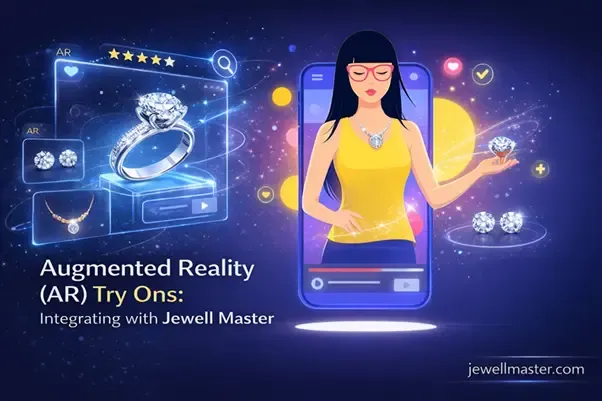
Augmented Reality in jewellery retail refers to the use of
advanced visualization technology that overlays digital jewellery designs onto
a customer’s real-world image using mobile devices or web cameras, enabling
them to virtually try rings, necklaces, earrings, and other ornaments without
physically wearing them, which significantly enhances the shopping experience by making it more interactive and personalized while reducing uncertainty in purchasing decisions. In an industry where design, fit, and appearance play a
critical role in customer satisfaction, AR bridges the gap between online and
offline shopping by allowing customers to visualize how a piece will look on
them in real time, thereby improving engagement, increasing trust, and reducing
hesitation that often leads to abandoned purchases, especially in online
jewellery sales.
Why AR Try-Ons are Important for Jewellery Businesses
Jewellery purchasing is a highly emotional and visual
decision-making process where customers want to see how a product looks on them
before making a purchase, making AR try-ons an essential tool for modern
jewellery businesses aiming to enhance customer experience and drive sales
growth. Traditional online shopping lacks the physical interaction that
customers experience in stores, leading to lower conversion rates and higher
return rates, while AR try-ons provide a realistic and interactive experience
that allows customers to make informed decisions with greater confidence. By
enabling customers to explore multiple designs, compare options, and visualize
products instantly, AR technology helps businesses increase engagement, improve
conversion rates, and reduce returns, ultimately leading to higher customer
satisfaction and improved profitability.
How AR Try-Ons Work in Jewellery Retail
AR try-on systems work by using camera-based technology
combined with advanced algorithms that detect facial features, hand movements,
or body positioning to accurately place digital jewellery items onto the
customer’s image in real time, creating a realistic visualization that mimics
actual product placement and movement. These systems use 3D models of jewellery
designs that are optimized for digital rendering, ensuring that details such as
size, shape, texture, and shine are accurately represented, allowing customers
to see how the product will look under different angles and lighting
conditions. By integrating AR with mobile applications or web platforms,
jewellery businesses can provide seamless virtual try-on experiences that are
accessible anytime and anywhere, enhancing convenience and engagement while
reducing the need for physical trials.
Key Benefits of AR Try-Ons for Jewellery Retailers
AR try-ons provide significant benefits to jewellery retailers by improving customer engagement, increasing sales conversions, and
enhancing overall shopping experience through immersive and interactive
technology that allows customers to explore products in a more personalized
way. By reducing uncertainty and providing realistic product visualization, AR
helps customers make confident purchasing decisions, leading to higher
conversion rates and lower return rates, while also enabling businesses to showcase
a wider range of designs without the need for physical inventory, thereby
reducing operational costs and improving inventory management efficiency.
Additionally, AR enhances brand perception by positioning businesses as
innovative and customer-centric, helping them stand out in a competitive
market.
Integrating AR Try-Ons with Jewell Master
Integrating AR try-ons with Jewell Master enables jewellery businesses to combine advanced visualization technology with powerful inventory
and billing management systems, creating a seamless and efficient digital
ecosystem that enhances both customer experience and operational efficiency.
Jewell Master provides real-time inventory data, product details, and pricing information that can be integrated with AR platforms to ensure that customers
only see available products during virtual try-ons, reducing discrepancies and
improving accuracy in product selection. This integration allows businesses to
track customer preferences, analyze engagement data, and optimize inventory
planning based on real-time insights, ensuring that high-demand designs are
always available while enhancing overall business performance through
data-driven decision making.
Challenges Solved by AR in Jewellery Retail
Jewellery retailers face challenges such as low online
conversion rates, high return rates, limited physical inventory display, and
difficulty in engaging customers digitally, all of which can impact business
growth and profitability in an increasingly competitive market. AR technology
addresses these challenges by providing an interactive and immersive shopping
experience that allows customers to visualize products before purchase,
reducing uncertainty and increasing confidence in buying decisions. By enabling
virtual trials and real-time product exploration, AR helps businesses overcome
the limitations of traditional online shopping, improve customer engagement,
and drive higher sales while reducing operational inefficiencies.
AR Try-Ons vs Traditional Jewellery Shopping
|
Aspect |
Traditional
Shopping |
AR Try-Ons |
|
Product
Experience |
Physical only |
Virtual +
Interactive |
|
Accessibility |
Store visit
required |
Anywhere,
anytime |
|
Product Range |
Limited
display |
Unlimited
digital catalogue |
|
Customer
Engagement |
Moderate |
High
engagement |
|
Conversion
Rate |
Lower |
Higher
conversions |
Key Features of AR Try-On Systems
- Real-time
virtual jewellery visualization
- 3D
product rendering with high accuracy
- Integration
with inventory and pricing systems
- Mobile
and web-based accessibility
- Personalized
product recommendations
- Customer
behaviour tracking and analytics
- Enhanced
digital shopping experience
Future of AR in Jewellery Retail
The future of jewellery retail is increasingly driven by
immersive technologies such as augmented reality, where businesses will focus
on creating highly personalized and engaging customer experiences that combine
digital convenience with realistic product interaction. As AR technology
continues to evolve, it will become more advanced, accurate, and accessible,
enabling jewellery retailers to offer enhanced virtual experiences that
replicate in-store interactions while also integrating with other technologies
such as artificial intelligence and data analytics to provide smarter
recommendations and insights. With platforms like Jewell Master supporting
digital transformation and operational management, businesses can seamlessly
adopt AR solutions and stay ahead of market trends, ensuring long-term growth
and competitive advantage.
Conclusion
Augmented Reality is transforming jewellery retail by enabling virtual try-on experiences that enhance customer engagement, improve buying confidence, and increase sales conversions through interactive and immersive technology. By integrating AR with Jewell Master, jewellery businesses can create a powerful digital ecosystem that combines advanced visualization with efficient inventory management, ensuring seamless operations and enhanced customer satisfaction. As the industry continues to evolve, adopting AR technology will be essential for businesses looking to stay competitive and deliver exceptional customer experiences in a rapidly changing market.
