Introduction
Understanding Production Cost Components in Jewellery Manufacturing
Every jewellery piece consists of several cost elements that
contribute to the final selling price. These costs include the weight and
purity of precious metals, the type and number of gemstones used, labour
charges associated with design complexity, and additional production expenses
such as polishing and finishing. Since jewellery manufacturing is highly
material-intensive, even small variations in metal weight or gemstone prices
can significantly affect production costs. Businesses must therefore track these
components carefully to maintain accurate pricing. By analyzing historical cost
patterns, AI systems can identify relationships between design characteristics,
metal usage, and production expenses. This data-driven approach enables
jewellery businesses to estimate future manufacturing costs more accurately and
plan inventory purchases accordingly.
Challenges of Traditional Jewellery Cost Forecasting
Traditional cost forecasting methods often rely on manual
calculations and static spreadsheets. While these methods may work for small
jewellery businesses with limited product ranges, they become inefficient when
dealing with hundreds of jewellery designs and fluctuating gold prices. Manual
forecasting methods typically depend on historical averages rather than
real-time data, which can lead to inaccurate cost predictions. Another
challenge arises when businesses attempt to estimate costs for newly designed
jewellery pieces that have never been manufactured before. Without proper
analytical tools, predicting the material and labour requirements for new
designs becomes difficult. As jewellery businesses grow, the limitations of
traditional forecasting methods become more evident, making advanced
data-driven solutions increasingly necessary.
How Artificial Intelligence Improves Cost Prediction
Artificial Intelligence uses advanced algorithms to analyze
large volumes of production and market data. By studying patterns in past
manufacturing activities, AI systems can identify trends that influence
production costs. For example, AI models can analyze how gold price
fluctuations affect jewellery pricing or how certain design types require
higher labour effort. AI tools can also predict how changes in gemstone prices
may impact the overall cost structure of jewellery pieces. Unlike manual
forecasting methods, AI systems continuously learn from new data and refine
their predictions over time. This dynamic approach enables jewellery businesses
to make more informed pricing and production decisions based on real-time
insights rather than static estimates.
Key Data Inputs Used for AI-Based Cost Forecasting
AI forecasting systems rely on multiple data sources to
generate accurate production cost predictions. These inputs allow the system to
analyze historical trends and estimate future manufacturing expenses.
• Historical gold and precious metal price trends
• Jewellery design specifications and metal weight data
• Gemstone type, quantity, and cost variations
• Labour cost patterns across different production stages
• Wastage percentages during manufacturing processes
• Production volume and order frequency
• Inventory consumption patterns over time
By combining these data inputs, AI forecasting systems
generate predictive insights that help jewellery businesses prepare for cost
fluctuations.
How AI Forecasting Supports Pricing Decisions
Pricing jewellery products requires a careful balance
between production cost and market competitiveness. When production costs
increase unexpectedly, businesses may struggle to maintain profit margins. AI
forecasting tools help jewellery retailers anticipate cost changes before they
occur, allowing them to adjust pricing strategies accordingly. For example, if
AI models detect a rising trend in gold prices, businesses can plan inventory
purchases early or revise product pricing to maintain profitability. AI
insights also help identify which jewellery designs deliver higher profit
margins based on production cost patterns. By using these predictive insights,
jewellery businesses can optimize product pricing while maintaining competitive
market positioning.
Typical Workflow of AI-Based Production Cost Forecasting
AI forecasting systems follow a structured process that
transforms historical data into predictive insights for jewellery
manufacturers.
|
Forecasting
Stage |
Purpose |
|
Data
Collection |
Gather
historical production and pricing data |
|
Data Analysis |
Identify cost
patterns and production trends |
|
AI Model
Training |
Train
algorithms using historical datasets |
|
Cost
Prediction |
Estimate
future production costs |
|
Pricing
Adjustment |
Update
product pricing strategies |
|
Inventory
Planning |
Plan raw
material purchases based on forecasts |
This structured workflow enables jewellery businesses to
make informed decisions regarding production planning and pricing strategies.
Benefits of AI Forecasting for Jewellery Manufacturers
AI-driven forecasting offers numerous advantages for
jewellery manufacturers and retailers. One of the most significant benefits is
improved accuracy in predicting production costs. Instead of relying on static
estimates, businesses can use data-driven insights to understand how material
prices and labour costs may change over time. AI forecasting also improves
financial planning because businesses can anticipate cost increases and adjust
procurement strategies accordingly. Another advantage is enhanced operational
efficiency because production managers gain insights into which designs are
more cost-effective to manufacture. Over time, jewellery businesses that adopt
AI forecasting tools can make smarter strategic decisions that improve
profitability and reduce financial uncertainty.
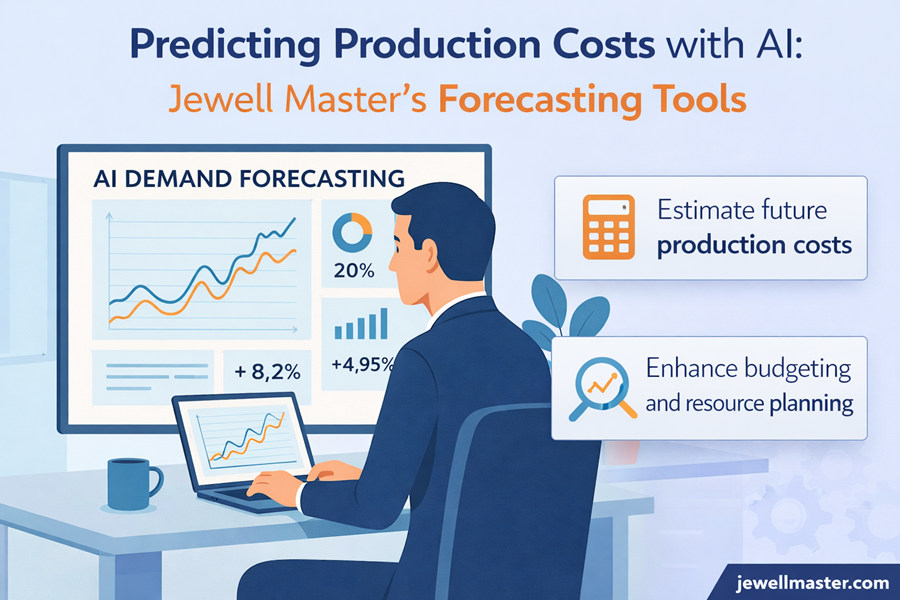
How Jewell Master Uses AI for Cost Forecasting
Jewell Master integrates advanced forecasting capabilities
that analyze jewellery production data and market trends to predict future
manufacturing costs. The platform processes historical information related to
metal consumption, gemstone usage, labour charges, and wastage percentages. By
analyzing these datasets, Jewell Master can generate cost forecasts for
different jewellery designs and production scenarios. Business owners can view
predictive reports that highlight potential cost increases or production
inefficiencies. These insights help jewellery manufacturers plan inventory
purchases, adjust pricing strategies, and optimize production schedules. Jewell
Master also integrates forecasting tools with its inventory and billing
modules, ensuring that predicted costs align with real-time business
operations.
Improving Business Planning with Predictive Insights
Predictive insights generated by AI forecasting tools enable
jewellery businesses to make proactive decisions rather than reactive
adjustments. Instead of responding to cost increases after they occur,
businesses can anticipate market changes and plan accordingly. For example, if
AI models indicate that gold prices are likely to increase in the coming
months, jewellery businesses may choose to purchase raw materials earlier to
secure lower prices. Predictive insights also help businesses determine which
product designs are most profitable based on production cost patterns. By
integrating forecasting tools into everyday operations, jewellery businesses
can improve strategic planning and reduce financial risk.
Conclusion
Predicting production costs accurately is essential for maintaining profitability in the jewellery industry. Because jewellery manufacturing relies heavily on precious metals and gemstones whose prices fluctuate frequently, traditional forecasting methods often struggle to keep up with market changes. Artificial Intelligence introduces a powerful solution by analyzing historical data and identifying patterns that influence manufacturing expenses. Jewell Master’s AI forecasting tools provide jewellery businesses with predictive insights that improve pricing strategies, inventory planning, and production management. By adopting AI-driven forecasting systems, jewellery manufacturers can reduce uncertainty, optimize operations, and maintain a competitive advantage in an increasingly dynamic market environment.
