Introduction
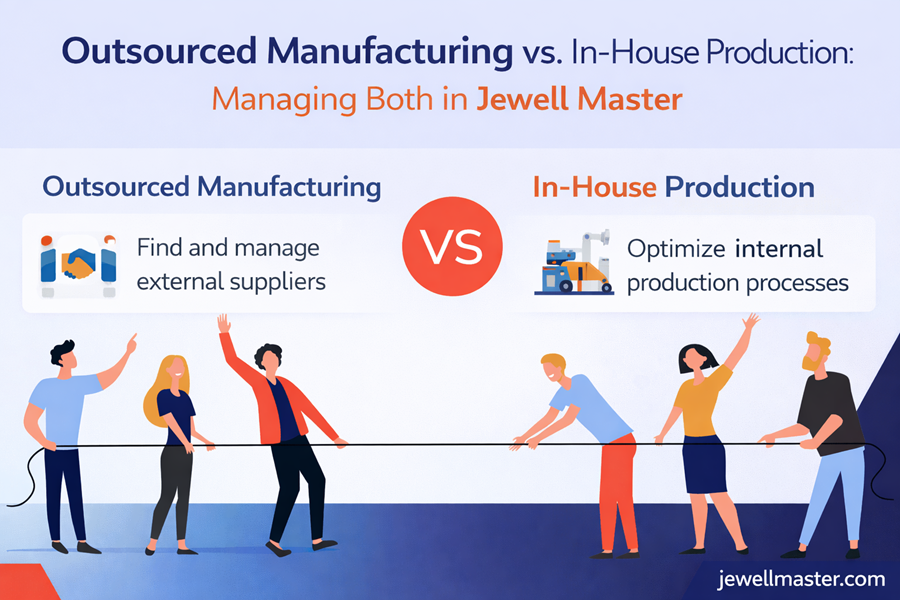
Understanding In-House Jewellery Manufacturing
In-house manufacturing refers to jewellery production that
takes place within the company’s own workshop or factory. In this model,
jewellery businesses employ karigars or artisans directly and provide them with
the necessary tools, raw materials, and workspace required for production. The
advantage of in-house manufacturing is that businesses maintain direct control
over every stage of the production process. Quality standards, design
modifications, and production timelines can be monitored closely because the
entire process occurs within the organization. In-house production is
particularly useful for jewellery businesses that specialize in custom designs
or high-value ornaments where quality control is critical. However, maintaining
an internal workshop also requires investments in equipment, skilled labour,
and operational management. Businesses must track raw materials issued to
artisans, monitor production progress, and ensure that wastage levels remain
within acceptable limits.
Understanding Outsourced Jewellery Manufacturing
Outsourced manufacturing involves sending jewellery designs
or production orders to external artisans, manufacturing units, or job workers
who complete the work outside the business premises. Many jewellery retailers use outsourced manufacturing to handle large production volumes or specialized
design work that requires unique skills. Outsourcing allows jewellery
businesses to expand production capacity without investing heavily in
infrastructure or full-time labour. External karigars may specialize in certain
techniques such as stone setting, casting, or intricate engraving. While
outsourcing offers flexibility and cost advantages, it also introduces
challenges related to tracking issued materials and monitoring production
timelines. Businesses must ensure that gold or gemstones issued to external
artisans are recorded accurately and that finished jewellery pieces are
returned according to the agreed specifications.
Why Jewellery Businesses Use a Hybrid Manufacturing Model
Many jewellery businesses combine in-house and outsourced
manufacturing to achieve a balance between quality control and production
scalability. In-house production is typically used for high-value designs,
custom orders, or products that require strict quality oversight. Outsourced
production, on the other hand, helps businesses handle bulk orders or
specialized work without increasing internal workforce costs. By using both
manufacturing methods, jewellery businesses can optimize production efficiency
while maintaining flexibility in responding to market demand. However, managing
this hybrid model requires careful monitoring of raw materials, labour costs,
and production timelines. Without proper management systems, businesses may
face difficulties in tracking metal issued to external job workers or
monitoring work completed within internal workshops.
Operational Challenges When Managing Both Production Models
Managing both in-house and outsourced manufacturing can
create several operational challenges for jewellery businesses. One major
challenge is tracking precious metal inventory because gold or silver must be
issued to both internal artisans and external job workers. If these
transactions are not recorded accurately, businesses may experience inventory
discrepancies. Another challenge involves monitoring production progress
because external artisans may not always provide real-time updates on work
completion. Businesses must also track labour charges separately for internal
employees and outsourced job workers, which complicates cost calculations. In
addition, maintaining consistent quality standards across both production
environments requires structured inspection procedures. Without centralized
management systems, coordinating these processes becomes difficult as
production volume grows.
Key Elements of Managing Hybrid Jewellery Manufacturing
To successfully manage both in-house and outsourced
production, jewellery businesses must track multiple operational factors within
a structured management system.
• Recording raw metal issued to internal karigars and
external job workers
• Tracking production orders assigned to different manufacturing units
• Monitoring work in progress for both internal and outsourced production
• Calculating labour costs and job work charges accurately
• Recording finished jewellery returned from external manufacturers
• Monitoring wastage and scrap recovery from different production sources
• Maintaining quality control across all production channels
When these elements are tracked systematically, jewellery
businesses can maintain accurate production records and operational
transparency.
How Hybrid Production Improves Business Scalability
Using a combination of in-house and outsourced production
allows jewellery businesses to scale their operations efficiently. Internal
workshops can focus on high-value custom designs while external manufacturing
partners handle large production volumes. This flexibility allows businesses to
respond quickly to changes in customer demand without overloading internal
production teams. Outsourcing also allows businesses to access specialized
craftsmanship that may not be available within their own workshops. At the same
time, maintaining an internal manufacturing capability ensures that businesses retain control over quality standards and design innovation. By balancing these
two production models effectively, jewellery businesses can increase production
capacity while maintaining operational efficiency.
Typical Workflow for Managing In-House and Outsourced Production
A structured workflow helps jewellery businesses maintain
visibility over production activities regardless of where manufacturing takes
place.
|
Production
Stage |
Purpose |
|
Design
Creation |
Jewellery
design finalized for production |
|
Job Order
Creation |
Assign
production task to internal or external unit |
|
Raw Material
Issue |
Gold and
gemstones issued for manufacturing |
|
Work in
Progress Tracking |
Monitor
production status |
|
Finished
Product Return |
Receive
completed jewellery from workshop or job worker |
|
Quality
Inspection |
Verify design
and finishing standards |
|
Inventory
Entry |
Transfer
approved jewellery into showroom stock |
This workflow ensures that production processes remain
organized and transparent across both manufacturing models.
Advantages of Managing Both Production Models Digitally
Digital production management systems provide significant
advantages when managing hybrid jewellery manufacturing models. By centralizing
production data within a single platform, businesses gain complete visibility
into both in-house and outsourced manufacturing activities. Digital systems
allow managers to track raw material movement, production progress, and labour
costs in real time. This transparency reduces the risk of inventory
discrepancies and ensures that metal issued to external artisans is properly
accounted for. Digital management systems also simplify reporting because
production data from multiple sources is stored within a unified database. Over
time, jewellery businesses that adopt digital management platforms achieve
better operational efficiency and improved financial control.
How Jewell Master Manages In-House and Outsourced Production
Jewell Master ERP provides advanced tools that help
jewellery businesses manage hybrid manufacturing models within a single
integrated platform. The system allows businesses to create production orders
and assign them either to internal workshops or external job workers. When raw
materials such as gold or gemstones are issued for manufacturing, the system
records the transaction and links it to the specific production order. Jewell
Master also tracks work in progress across different production environments,
allowing managers to monitor production status in real time. Once the jewellery
piece is completed, the system records the finished product return and updates
inventory automatically. The platform also supports labour cost calculations,
job work charges, and wastage monitoring. By integrating these functions within
a single system, Jewell Master ensures that jewellery businesses maintain
complete control over production activities regardless of where the jewellery
is manufactured.
Maintaining Quality Consistency Across Production Channels
Quality consistency is essential when jewellery pieces are
manufactured through multiple production channels. Businesses must ensure that
jewellery produced internally and externally meets the same design
specifications and finishing standards. Structured quality control procedures
help maintain this consistency by inspecting jewellery pieces before they are
added to showroom inventory. Digital management systems also help maintain
design documentation so that external job workers receive accurate production
instructions. By combining strict quality control practices with digital
production tracking, jewellery businesses can ensure that all jewellery pieces
meet their brand’s quality standards.
Conclusion
Managing both outsourced and in-house manufacturing is a common strategy used by jewellery businesses to balance production flexibility and operational efficiency. While in-house workshops provide greater control over quality and customization, outsourced manufacturing helps businesses scale production and access specialized craftsmanship. However, managing this hybrid production model requires careful monitoring of raw materials, labour costs, and production progress. Without structured systems, businesses may face inventory discrepancies and operational inefficiencies. Jewell Master ERP provides a comprehensive solution that integrates production management, inventory tracking, and job work monitoring within a single platform. By using Jewell Master to manage both in-house and outsourced manufacturing, jewellery businesses can maintain complete visibility over production operations while ensuring accurate inventory and cost management.