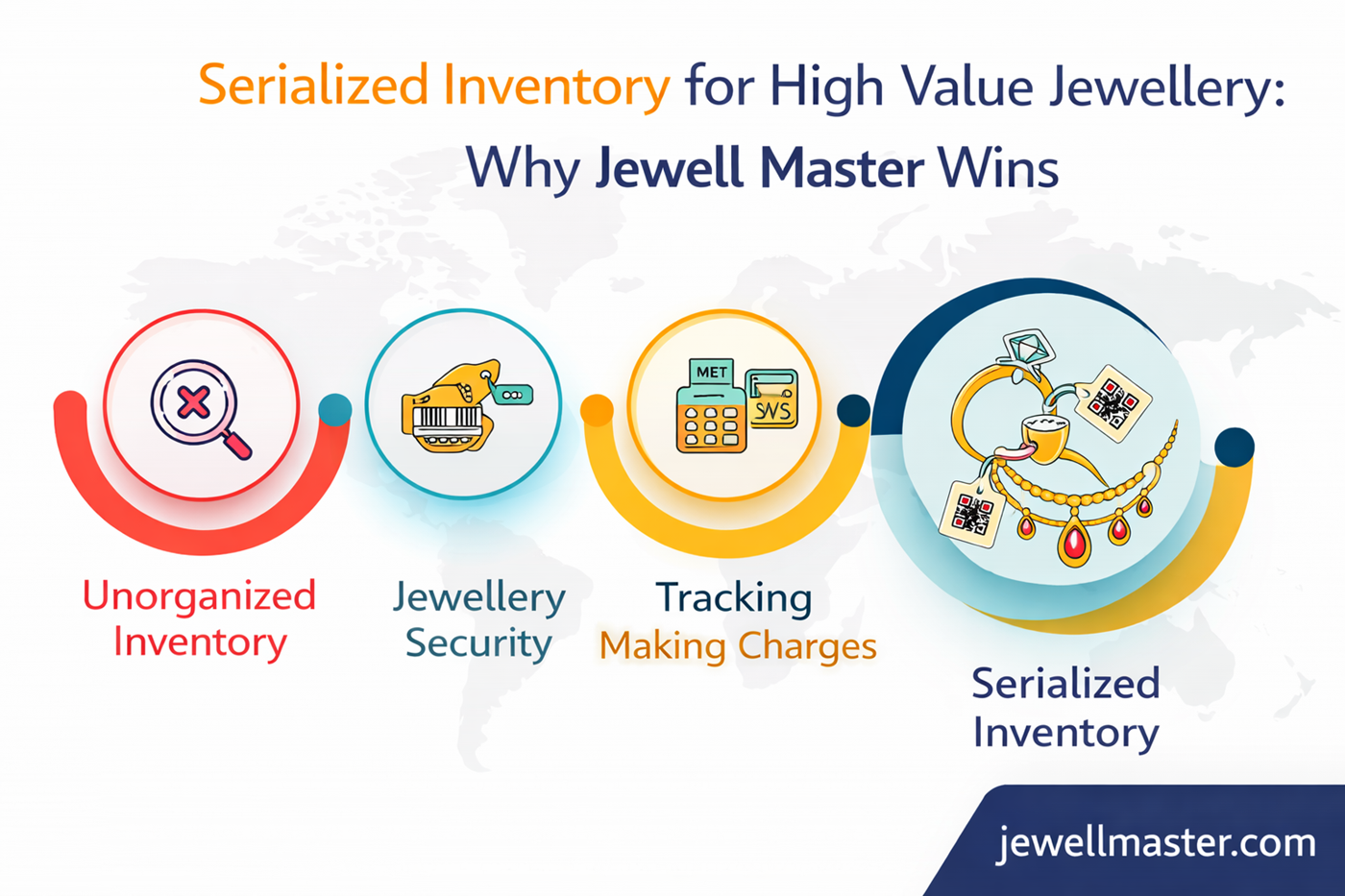
Introduction
Why High Value Jewellery Requires Serialized Inventory Management
High-value jewellery items such as diamond necklaces, bridal
sets, designer bangles, and exclusive gold ornaments carry substantial
financial value and unique craftsmanship. Unlike general retail products that
can be counted in bulk quantities, jewellery inventory must often be tracked
individually because each piece has a unique weight, purity level, design
style, and valuation. Without serialized tracking, jewellery businesses may
struggle to maintain accurate records of individual pieces. When inventory is
recorded only by total weight or category, it becomes difficult to trace
specific items, especially when customers request a particular design or when
stock is transferred between branches. Serialized inventory assigns a unique
identification number to every jewellery piece, allowing businesses to monitor
its entire lifecycle from purchase to sale. This approach ensures that each
item remains traceable throughout the inventory system. Jewell Master
integrates serialized inventory management directly into its ERP platform,
enabling jewellery retailers to track every high-value item individually while
maintaining precise inventory records.
Understanding the Concept of Serialized Jewellery Inventory
Serialized inventory refers to a tracking system where each
individual product unit receives a unique serial number or identification code.
In jewellery retail, this serial number may represent a unique product ID that
includes information about weight, design category, metal purity, stone
details, and purchase value. By assigning a unique identifier to every piece,
jewellers can track the movement of that item across billing, inventory
transfers, repairs, or returns. Serialized tracking ensures that every jewellery
item is accounted for within the system at all times. Instead of simply knowing
that ten gold rings are in stock, the retailer can see exactly which specific
rings are available and where they are located. This detailed level of tracking
becomes extremely important for high-value items such as diamond jewellery or
customized pieces. Serialized inventory management therefore provides jewellery
businesses with greater control, accuracy, and transparency in their
operations.
Problems with Non-Serialized Jewellery Inventory Systems
Many jewellery stores still rely on traditional inventory
systems that track items by weight or product category rather than individual
identification. While this method may appear simple, it introduces several
operational risks. Without serialization, it becomes difficult to determine
which exact piece of jewellery has been sold, transferred, or returned. This
lack of clarity can lead to inventory mismatches and reconciliation challenges
during audits. Another common issue occurs when multiple pieces of jewellery
share similar descriptions, making it difficult for staff to distinguish
between them in the system. In busy showrooms, employees may accidentally bill
the wrong item or record incorrect stock adjustments. Non-serialized systems
also make it harder to track product history, such as when a particular
jewellery item was purchased, transferred, or displayed in different branches.
These limitations highlight the importance of adopting serialized inventory
systems designed specifically for jewellery businesses.
How Jewell Master Implements Serialized Inventory Tracking
Jewell Master introduces serialized inventory tracking as a
core feature within its jewellery ERP platform. When new jewellery items are
purchased or manufactured, the system automatically generates a unique
identification number for each piece. This serial number becomes the primary
tracking reference throughout the item’s lifecycle. Every transaction involving
the jewellery piece whether it is sold, transferred, repaired, or returned is
recorded against that unique serial number. As a result, store managers can
instantly see the full history of each item within the system. Serialized
tracking also ensures that billing staff select the correct jewellery piece
during sales transactions. Because each item is uniquely identified, there is
no confusion between similar designs or products with comparable weight. This
level of control significantly improves inventory accuracy and reduces
operational risk.
Tracking High Value Diamond Jewellery with Serialization
Diamond jewellery represents some of the most valuable
inventory within jewellery stores. Each diamond piece often carries unique
specifications such as carat weight, clarity grade, colour classification, and
certification details. Tracking such items through bulk inventory methods can
lead to serious inaccuracies. Serialized inventory management ensures that
every diamond jewellery piece is tracked individually with complete product
information attached to its unique identification code. Jewell Master allows
jewellers to store detailed diamond attributes alongside the serial number,
ensuring that each piece remains fully traceable. When a customer purchases a
diamond ornament, the system records the exact item sold along with its
certification data. This level of precision protects both the retailer and the
customer by ensuring complete transparency in high-value transactions.
Non-Serialized Inventory vs Serialized Jewellery Inventory
|
Feature |
Non-Serialized
Inventory |
Jewell
Master Serialized Inventory |
|
Product
Identification |
Category or
weight-based |
Unique serial
number for each piece |
|
Tracking
Accuracy |
Limited
visibility |
Complete
item-level tracking |
|
Diamond
Jewellery Management |
Difficult to
monitor |
Detailed
item-specific tracking |
|
Inventory
Audits |
Time-consuming
reconciliation |
Clear
traceable records |
|
Error Risk |
Higher risk
of mistakes |
Highly
accurate system tracking |
Real-Time Inventory Visibility for High Value Items
Jewellery retailers must maintain complete visibility over
their inventory at all times, particularly when dealing with expensive
products. Serialized inventory systems allow managers to monitor the exact
location and status of every jewellery piece. Jewell Master provides a
centralized dashboard where store owners can instantly check whether a specific
item is available in a particular branch or showroom. This visibility improves
operational decision-making because management can quickly identify which branch
holds certain designs. If a customer requests a specific piece that is
unavailable in one location, staff can locate the item in another branch and
arrange a transfer. Real-time visibility ensures that jewellery businesses
maximize sales opportunities while maintaining accurate inventory records.
Advantages of Serialized Inventory Tracking
- Unique
identification for every jewellery piece
- Complete
traceability from purchase to sale
- Improved
accuracy in inventory records
- Easier
tracking of high-value diamond jewellery
- Simplified
stock audits and reconciliation
- Reduced
risk of billing the wrong item
- Better
transparency in jewellery transactions
Operational Impact of Serialized Inventory Systems
|
Business
Area |
Traditional
Inventory Method |
Jewell
Master Serialized System |
|
Inventory
Accuracy |
Frequent
discrepancies |
Highly
precise tracking |
|
Product
Identification |
Generic
category tracking |
Unique serial
numbers |
|
Audit
Efficiency |
Difficult
verification |
Quick
traceable records |
|
Diamond
Jewellery Control |
Limited
product detail |
Complete
specification tracking |
|
Branch
Transfers |
Risk of
confusion |
Item-level
transfer tracking |
How Serialization Improves Branch Transfers
Branch transfers are common in jewellery businesses,
particularly when customers request specific designs from different showroom
locations. Without serialized tracking, transferring jewellery items between
branches can create confusion because staff may not know which exact piece was
moved. Jewell Master solves this issue by linking every transfer transaction to
the item’s unique serial number. When an item is transferred, the system
records the movement and updates the inventory location automatically. This
ensures that the jewellery piece is always associated with the correct branch
within the system. Serialized transfer tracking also provides a clear audit
trail, allowing management to monitor the movement of high-value items across
the organization. This level of control greatly reduces the risk of inventory
misplacement or duplication.
Improving Inventory Audits with Serialized Jewellery Records
Inventory audits are essential for jewellery businesses
because they ensure that physical stock matches recorded inventory data.
However, audits can become extremely complex when inventory systems do not
track items individually. Serialized inventory simplifies the audit process by
allowing auditors to verify each jewellery item through its unique
identification number. Jewell Master enables businesses to generate detailed
reports that list every serialized jewellery piece currently in stock. Auditors
can quickly compare these records with physical inventory during verification
procedures. Because every item is uniquely identified, discrepancies can be
detected immediately. This level of audit transparency helps jewellery retailers maintain financial accuracy and regulatory compliance.
Additional Operational Benefits of Serialized Jewellery Inventory
- Faster
item identification during customer inquiries
- Better
management of high-value inventory assets
- Clear
product history for each jewellery piece
- Reduced
operational risk in multi-branch operations
- Improved
financial reporting accuracy
Technology Trends Driving Serialized Inventory Adoption
The jewellery industry is increasingly adopting advanced ERP systems that incorporate serialized inventory tracking as a standard feature. As jewellery businesses expand into multiple branches and online sales channels, the need for precise inventory control becomes even more critical. Serialized tracking allows businesses to maintain complete visibility over individual items while integrating inventory data with billing, pricing, and financial reporting modules. Modern ERP platforms such as Jewell Master combine serialized inventory with cloud-based synchronization, enabling jewellery retailers to manage high-value inventory efficiently across locations. Businesses that adopt serialized systems early gain a strong advantage in operational accuracy and customer trust
Conclusion
Managing high-value jewellery inventory requires a level of
precision that traditional inventory systems often cannot provide. Without
individual tracking, jewellery retailers face challenges in identifying
specific items, conducting audits, and managing branch transfers. Serialized
inventory management solves these problems by assigning unique identification
numbers to every jewellery piece, enabling complete traceability throughout the
product lifecycle. Jewell Master integrates this advanced tracking capability
directly into its ERP platform, allowing jewellers to monitor inventory with
exceptional accuracy. From diamond jewellery management to multi-branch
inventory synchronization, serialized tracking ensures that every high-value
item remains accounted for at all times. By adopting serialized inventory
systems, jewellery businesses can strengthen operational control, protect
valuable assets, and deliver a more transparent and trustworthy experience for
customers.
