Introduction
Why Jewellery Businesses Use Separate Warehouses and Showrooms
Jewellery retailers often operate with two different
inventory environments: warehouses and showrooms. Warehouses store bulk
jewellery stock, raw materials, and backup inventory, while showrooms display
selected pieces for customer viewing and sales. This separation helps
businesses manage large inventory volumes while maintaining attractive product
displays in retail spaces. However, managing stock between these two locations
can become extremely complex without a centralized system. Manual tracking methods
often fail to update stock records accurately when products move between
warehouses and showrooms. This leads to confusion about product availability
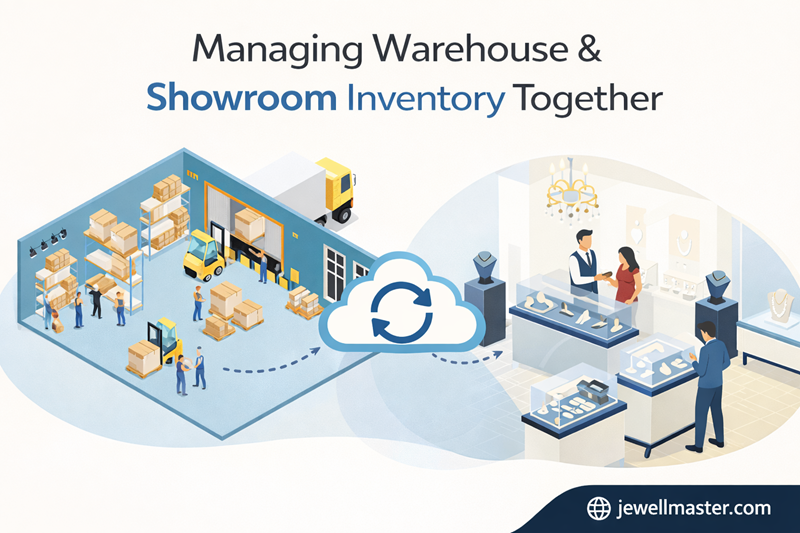
and may cause operational delays. Jewell Master eliminates these issues by
synchronizing warehouse and showroom inventory into a single centralized system
that tracks every stock movement accurately.
Challenges of Managing Warehouse and Showroom Stock Manually
Many jewellery businesses still rely on spreadsheets or
manual registers to manage warehouse and showroom inventory separately. This
approach creates multiple operational problems. One major issue is delayed
inventory updates when products are transferred from warehouses to showrooms.
If the transfer is not recorded immediately, stock reports may show incorrect
quantities in both locations. Another challenge is the difficulty of
identifying which products are currently available for display or sale. Without
centralized inventory tracking, showroom staff may struggle to locate items
stored in the warehouse. These operational inefficiencies can affect customer
service and slow down sales processes. Jewell Master addresses these challenges
by providing real-time inventory synchronization between warehouses and
showrooms.
Real Time Stock Synchronization Between Locations
Real-time synchronization ensures that every inventory
movement is recorded instantly within the system. When jewellery items are
transferred from the warehouse to the showroom, Jewell Master automatically
updates the inventory database for both locations. This ensures that warehouse
stock decreases while showroom inventory increases simultaneously. Similarly,
if products are returned from the showroom to the warehouse for storage or
repair, the system updates the records immediately. This real-time tracking
ensures that inventory reports always reflect accurate stock levels across all
locations. With synchronized inventory data, jewellery retailers can avoid
stock mismatches and maintain operational transparency.
Simplifying Stock Transfers Between Warehouse and Showroom
Stock transfers between warehouses and showrooms are common
in jewellery businesses because retailers frequently rotate their collections
to match customer demand. Jewell Master simplifies this process by providing
structured transfer workflows within the system. Store managers can initiate
inventory transfers digitally and track the movement of each jewellery item
throughout the process. The system records the transfer details, including
product identification, quantity, weight, and destination location. This
digital transfer process eliminates the need for manual record keeping and
ensures that inventory movements remain traceable at all times.
Improving Inventory Visibility for Sales Teams
Sales teams rely heavily on accurate inventory information
to serve customers effectively. If showroom staff cannot determine whether a
specific jewellery piece is available in the warehouse, they may lose potential
sales opportunities. Jewell Master provides a centralized dashboard that allows
staff to view inventory across warehouses and showrooms in real time. When
customers request a specific jewellery design that is not currently on display,
sales staff can instantly check warehouse availability and arrange a quick
transfer. This level of visibility improves customer satisfaction and increases
sales conversion rates.
Centralized Inventory Reporting Across Locations
Accurate reporting is essential for managing inventory
efficiently across warehouses and showrooms. Jewell Master generates detailed
reports that show stock distribution across all business locations. These
reports allow store managers to analyze which jewellery designs are performing
well in showrooms and which items remain in warehouse storage. This information
helps businesses optimize inventory distribution and ensure that high-demand
jewellery pieces are available where customers are most likely to purchase
them. Centralized reporting also simplifies stock audits because all inventory
data is maintained within a unified system.
Key Benefits of Managing Warehouse and Showroom Inventory Together
• Real-time inventory synchronization between locations
• Accurate tracking of jewellery transfers
• Improved stock visibility for showroom staff
• Centralized inventory reporting across all locations
• Reduced risk of stock mismatches
• Faster inventory audits and verification
• Better inventory distribution strategies
Manual Warehouse Management vs Jewell Master Inventory System
|
Feature |
Manual
Inventory Management |
Jewell
Master ERP |
|
Inventory
Updates |
Delayed
entries |
Real-time
synchronization |
|
Warehouse to
Showroom Transfers |
Manual
records |
Automated
tracking |
|
Inventory
Visibility |
Limited |
Centralized
dashboard |
|
Stock
Accuracy |
Often
mismatched |
Highly
accurate |
|
Reporting |
Basic reports |
Advanced
analytics |
Operational Improvements After Implementing Jewell Master
|
Business
Area |
Before
Implementation |
After
Using Jewell Master |
|
Inventory
Accuracy |
Frequent
discrepancies |
Accurate
stock records |
|
Transfer
Tracking |
Manual
processes |
Automated
workflows |
|
Sales
Efficiency |
Limited
product visibility |
Real-time
stock visibility |
|
Inventory
Planning |
Guesswork |
Data-driven
decisions |
|
Operational
Efficiency |
Time
consuming |
Streamlined
operations |
Why Jewellery Businesses Need Unified Inventory Systems
As jewellery businesses grow, managing inventory across multiple locations becomes increasingly complex. Warehouses store large volumes of products, while showrooms handle customer-facing sales operations. Without a unified system, these two environments may operate independently, leading to stock confusion and operational inefficiencies. Jewell Master bridges this gap by connecting warehouse and showroom inventory into a single integrated platform. This unified system ensures that every stock movement is recorded instantly and that all teams have access to accurate inventory data. By adopting centralized inventory management, jewellery retailers can improve operational efficiency and maintain complete control over their stock.
Conclusion
Managing warehouse and showroom inventory together is
essential for maintaining accurate stock records and ensuring efficient jewellery retail operations. Manual systems often struggle to track product
movement between locations, leading to stock mismatches and operational delays.
Jewell Master solves this problem by providing a centralized inventory management platform that synchronizes warehouse and showroom stock in real
time. Through automated transfer tracking, centralized reporting, and real-time
visibility, the system enables jewellery businesses to manage their inventory
more efficiently and deliver a better customer experience.
