Introduction
Understanding Multi Location Jewellery Manufacturing
As jewellery businesses grow, they often establish multiple
manufacturing units to handle increasing production demand. Some units may
specialize in casting and mould preparation, while others focus on stone
setting, polishing, or finishing. In addition, businesses may operate separate
workshops for custom jewellery designs or bulk production. Multi-location
manufacturing allows jewellery businesses to distribute workload efficiently
and reduce production bottlenecks. However, this operational model also requires
careful coordination between different units to ensure that production
schedules remain aligned. Without centralized oversight, it becomes difficult
to track which unit is responsible for specific production tasks or how raw
materials are being used across locations.
Why Centralised Monitoring is Essential for Jewellery Businesses
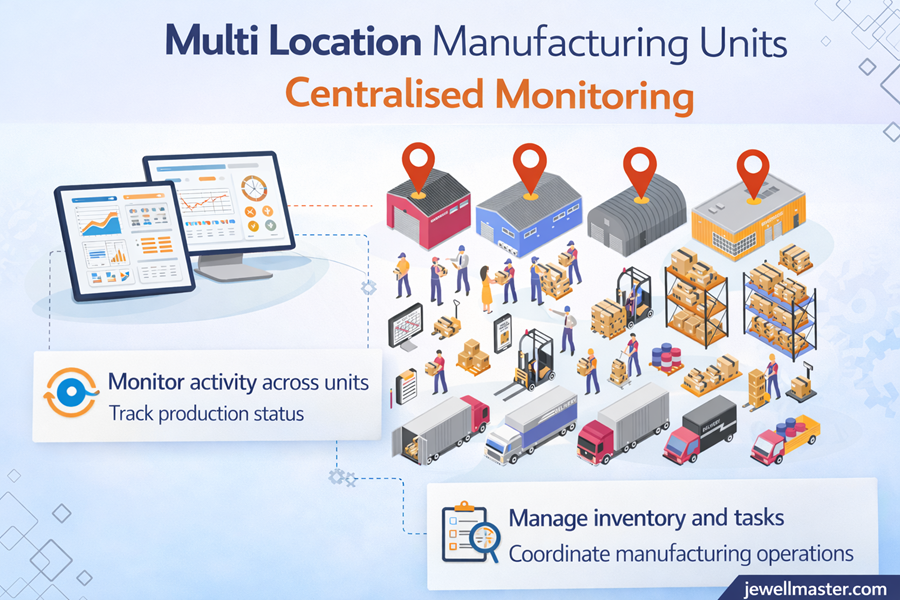
Centralised monitoring allows jewellery businesses to manage
multiple manufacturing units from a single digital platform. Instead of
maintaining separate records for each workshop, all production data is stored
within a centralized system that provides real-time insights into manufacturing
activities. This approach improves operational transparency because managers
can view production progress, inventory levels, and labour activities across
all units simultaneously. Centralised monitoring also helps prevent inventory
discrepancies because precious metals issued to different locations are
recorded within the same system. By maintaining unified data across
manufacturing units, jewellery businesses can ensure that production activities
remain organized and efficient.
Challenges of Managing Multiple Manufacturing Locations
Managing multiple jewellery manufacturing units without a
centralized system can create several operational challenges. One major issue
is inventory tracking because raw metals and gemstones may be distributed
across different workshops. Without accurate monitoring, businesses may
struggle to determine how much inventory is available at each location. Another
challenge involves production coordination because different units may work on
separate stages of the same jewellery piece. If communication between units is
not properly managed, delays may occur that disrupt production schedules.
Quality control can also become difficult because maintaining consistent
manufacturing standards across multiple workshops requires structured
monitoring. As jewellery businesses expand their operations, these challenges
highlight the need for centralized management systems.
Key Operational Data Tracked Across Multiple Units
Effective centralized monitoring requires jewellery businesses to track various operational elements across all manufacturing
locations.
• Raw metal and gemstone inventory at each production unit
• Production orders assigned to specific manufacturing locations
• Work in progress status across different workshops
• Karigar assignments and labour activities in each unit
• Wastage and scrap recovery during manufacturing processes
• Quality inspection results from different production locations
• Finished jewellery transfers between manufacturing units and showrooms
Tracking these elements within a centralized system ensures
that production activities remain transparent and well organized.
How Centralised Monitoring Improves Inventory Management
Precious metal inventory is one of the most valuable assets
in jewellery businesses, making accurate tracking essential. When manufacturing
units operate in different locations, raw materials such as gold or silver must
be distributed across workshops for production. Without centralized monitoring,
businesses may struggle to determine the exact quantity of metal available at
each location. Centralised inventory systems ensure that every material
transfer between units is recorded digitally. This allows business owners to
view real-time inventory levels across all manufacturing locations. Accurate
inventory monitoring helps prevent shortages, reduces the risk of material
loss, and ensures that production planning remains efficient.
Typical Workflow for Multi Location Manufacturing Management
A structured workflow helps jewellery businesses coordinate
production activities across multiple manufacturing units.
|
Process
Stage |
Purpose |
|
Production
Order Creation |
Define
jewellery design and assign production unit |
|
Raw Material
Distribution |
Issue metals
and gemstones to specific location |
|
Work in
Progress Tracking |
Monitor
production stages across units |
|
Inter Unit
Transfer |
Move
jewellery pieces between workshops if required |
|
Quality
Inspection |
Verify
product quality before completion |
|
Finished
Goods Entry |
Add completed
jewellery to central inventory |
|
Sales and
Billing |
Sell products
through showroom or retail channels |
This workflow ensures that production activities remain
coordinated across all manufacturing units.
Benefits of Centralised Manufacturing Management
Centralised manufacturing management provides several
advantages for jewellery businesses that operate multiple production units. One
major benefit is improved operational visibility because managers can monitor
production progress across all locations in real time. Centralised systems also
simplify reporting by consolidating data from multiple workshops into a single
dashboard. This allows business owners to analyze production efficiency, labour
productivity, and inventory usage across different units. Another advantage is
improved coordination between departments because production data is accessible
to managers and supervisors across the organization. Over time, businesses that
adopt centralized monitoring systems can manage larger manufacturing networks
while maintaining operational efficiency.
How Jewell Master Enables Centralised Monitoring
Jewell Master ERP provides a comprehensive platform for
managing multi-location jewellery manufacturing operations. The system connects
all workshops and production units within a single digital environment,
allowing business owners to monitor production activities across locations in
real time. When raw metals or gemstones are issued to a specific unit, the
system records the transaction and updates inventory records automatically.
Jewell Master also tracks work in progress across different manufacturing stages
and allows managers to view production status for each unit through centralized
dashboards. The platform supports inter-unit transfers of jewellery pieces,
ensuring that production tasks can move smoothly between locations when
necessary. With integrated reporting tools, Jewell Master enables jewellery
businesses to analyze production performance across all manufacturing units.
Improving Decision Making with Real Time Insights
Real-time insights generated by centralized monitoring
systems allow jewellery businesses to make informed operational decisions.
Managers can quickly identify which manufacturing units are operating at full
capacity and which locations have available resources for additional
production. This information helps businesses allocate production orders more
efficiently and reduce delays. Real-time monitoring also helps identify
potential issues such as production bottlenecks or inventory shortages before
they affect overall operations. By using data-driven insights, jewellery
businesses can optimize production planning and maintain smooth coordination
across multiple manufacturing units.
Conclusion
Managing multiple jewellery manufacturing units requires careful coordination and accurate tracking of production activities. Without centralized monitoring systems, businesses may struggle to maintain inventory accuracy, production transparency, and quality consistency across locations. Centralised monitoring provides a powerful solution by connecting all manufacturing units within a unified digital platform. Jewell Master ERP enables jewellery businesses to track production orders, monitor inventory levels, and analyze performance across multiple locations in real time. By implementing centralized management systems, jewellery businesses can scale their operations efficiently while maintaining complete control over manufacturing processes. This integrated approach ultimately improves operational efficiency and supports sustainable business growth.
