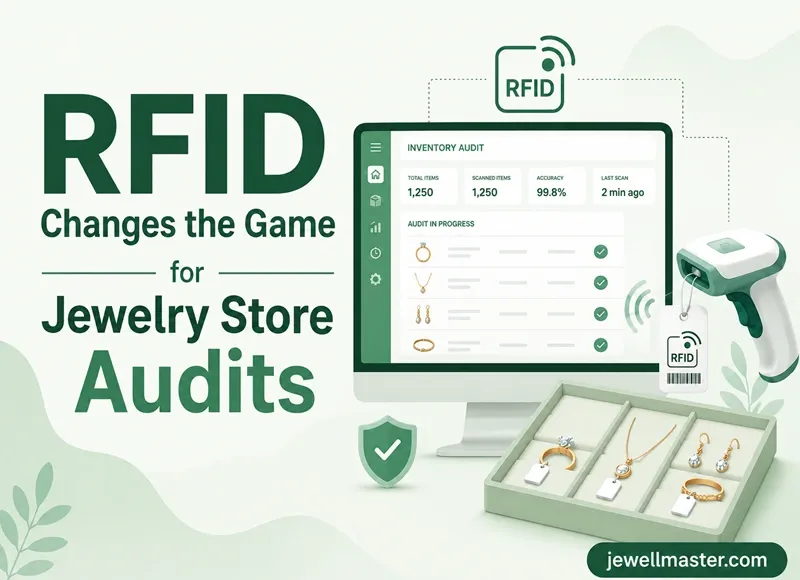
Introduction
Why Jewellery Store Audits Matter More Than Ever
Inventory is the heart of every jewellery business. Whether
you operate a retail showroom, wholesale business, or manufacturing unit,
maintaining accurate stock records is essential for profitability and customer
trust. Jewellery stores handle high-value products such as gold jewellery,
diamond jewellery, loose gemstones, and custom-made pieces that require strict
inventory control. Regular audits help businesses identify stock discrepancies,
prevent inventory shrinkage, and ensure financial accuracy. However,
traditional audit methods often consume significant time and resources. Staff
members manually count inventory, verify records, and investigate mismatches,
making the process labour-intensive and prone to human error. As jewellery
businesses grow, manual audits become increasingly difficult to manage. This
challenge has encouraged many businesses to adopt RFID technology for jewellery
inventory management and faster auditing processes.
What Is RFID Technology in Jewellery Management?
RFID stands for Radio Frequency Identification, a technology
that uses electronic tags and wireless readers to identify and track inventory
automatically. Each jewellery item receives a unique RFID tag containing
important product information such as item code, weight, purity, design
details, and inventory status. RFID readers communicate with these tags using
radio waves, allowing inventory to be identified without direct physical
contact. Unlike traditional barcode systems that require individual scanning,RFID technology can read multiple jewellery items simultaneously. This
capability dramatically improves inventory visibility and operational
efficiency. Jewellery businesses worldwide are increasingly adopting RFID
inventory management systems because they provide accurate, real-time stock
tracking and significantly reduce manual workload.
The Problems with Traditional Jewellery Audits
Traditional jewellery audits typically involve physically
counting every item and comparing the results with inventory records. While
this method can be effective, it is often time-consuming and highly dependent
on employee accuracy. Businesses with thousands of jewellery pieces may spend
several days completing a full inventory audit. During this period, employees
are diverted from customer-facing activities and other operational
responsibilities. Human errors such as missed items, incorrect counts, or data
entry mistakes can create inventory discrepancies. Additionally, delayed audit
results make it difficult to identify the source of stock issues. These
challenges increase operational costs and reduce inventory accuracy. Jewellery retailers looking to streamline inventory management are increasingly turning
to RFID technology as a modern alternative to manual auditing methods.
How RFID Makes Inventory Audits Faster
One of the most significant advantages of RFID technology is
its ability to accelerate inventory audits. Instead of scanning or counting jewellery
items individually, employees can use handheld RFID readers to scan entire
showcases, storage areas, or vaults within seconds. Multiple items are
identified simultaneously, reducing the time required for inventory
verification. A process that previously took hours or days can often be
completed in minutes. Faster audits allow jewellery businesses to conduct
inventory checks more frequently without disrupting daily operations. Frequent
audits improve inventory accuracy, reduce shrinkage risks, and provide greater
confidence in stock records. RFID transforms inventory auditing from a burdensome
task into a quick and efficient process.
Real-Time Inventory Visibility and Accuracy
RFID technology provides real-time visibility into inventory
movements throughout the business. As items are scanned, inventory records are
updated automatically within the jewellery management software. Managers can
immediately see which items are present, missing, transferred, or sold. This
real-time synchronisation eliminates delays associated with manual data entry
and inventory reconciliation. Businesses gain access to accurate inventory
information at all times, improving operational decision-making. Enhanced
visibility helps staff locate products quickly, respond to customer inquiries
more effectively, and maintain consistent inventory records across departments.
Accurate inventory data also improves financial reporting and inventory
valuation processes.
Reducing Inventory Shrinkage and Losses
Inventory shrinkage is a major concern for jewellery
businesses because even a small loss can have a significant financial impact.
RFID technology helps reduce shrinkage by providing complete visibility into
inventory movements. Every tagged item can be tracked throughout its lifecycle,
creating accountability and transparency. Businesses can quickly identify
missing items, investigate discrepancies, and detect unusual inventory
activity. Because audits can be performed more frequently, losses are often
discovered sooner than with traditional inventory methods. Early detection
allows businesses to take corrective action before small issues become major
problems. Improved inventory control ultimately protects profitability and
strengthens operational security.
Enhancing Security Through RFID Tracking
Security is one of the primary reasons jewellery businesses
invest in RFID technology. RFID systems maintain detailed audit trails showing
when inventory was moved, scanned, or transferred. This information creates a
transparent record of inventory activity and helps businesses monitor valuable
assets more effectively. Some RFID solutions can also trigger alerts when
tagged jewellery items move through unauthorised areas. These capabilities
strengthen inventory security and reduce opportunities for theft or
misplacement. By combining inventory management with advanced tracking
capabilities, RFID provides an additional layer of protection for high-value jewellery
inventory.
Multi-Store Inventory Audits Become Easier
Many jewellery businesses operate multiple retail locations,
warehouses, or manufacturing facilities. Managing inventory across these
locations can be challenging when stock records are fragmented or updated
manually. RFID technology enables centralised inventory management by synchronising
audit data across all locations. Managers can view inventory levels, audit
results, and stock movements from a single dashboard. This centralised
visibility simplifies inventory control and improves operational consistency.
Multi-location jewellery businesses benefit from faster reporting, improved
inventory accuracy, and more efficient decision-making. RFID helps create a
connected inventory ecosystem that supports business growth and scalability.
How Jewell Master Supports RFID-Based Auditing
Jewell Master integrates advanced RFID technology into its jewellery
management platform, helping businesses perform inventory audits with greater
speed and accuracy. The software automatically captures RFID data, updates
inventory records in real time, and generates detailed audit reports. Managers
can instantly identify discrepancies, monitor inventory movements, and review
stock performance from a centralised dashboard. Jewell Master also supports
barcode tracking, multi-location inventory management, sales integration,
manufacturing workflows, and business analytics. By combining RFID technology
with jewellery-specific management tools, the platform helps businesses improve
inventory control while reducing operational costs and manual effort.
RFID vs Traditional Jewellery Audits
|
Audit
Feature |
Traditional
Audit |
RFID Audit |
|
Audit Speed |
Slow |
Very Fast |
|
Inventory
Accuracy |
Moderate |
Very High |
|
Human Error
Risk |
High |
Very Low |
|
Real-Time
Updates |
No |
Yes |
|
Labor
Requirement |
High |
Low |
|
Multi-Store
Visibility |
Limited |
Excellent |
|
Audit
Frequency |
Monthly/Quarterly |
Daily/Weekly |
|
Missing Item
Detection |
Difficult |
Easy |
Future of RFID in Jewellery Inventory Management
RFID adoption continues to grow as jewellery businesses recognise
the benefits of automated inventory management and real-time visibility. Future
RFID systems will integrate more closely with artificial intelligence,
predictive analytics, and cloud-based management platforms. Businesses will
gain deeper insights into inventory trends, customer demand, and operational
performance. As technology costs decrease and capabilities expand, RFID is
expected to become a standard feature in modern jewellery inventory managementsystems. Companies that adopt RFID today position themselves for greater
efficiency, stronger inventory control, and long-term competitive advantage.
Conclusion
RFID technology has revolutionised jewellery store audits by making inventory verification faster, more accurate, and significantly more efficient. Businesses can reduce audit times from days to minutes while improving inventory visibility and reducing shrinkage risks. Real-time tracking, enhanced security, and centralised inventory management make RFID one of the most valuable technologies available to modern jewellery businesses. With integrated solutions like Jewell Master, jewellery retailers, wholesalers, and manufacturers can leverage RFID to streamline operations, improve inventory accuracy, and support sustainable business growth.
Related Blog
- RFID for Jewellery: Real-World Examples of How It Works
- How Jewellery Businesses Use RFID for Faster Audits
- Best Way to Track Loose Diamonds and Gemstones
