Introduction
Why Compliance Accuracy Matters in the Jewellery Industry
Jewellery businesses operate in one of the most tightly
monitored retail sectors because every transaction involves high monetary value
and precious metals. Regulatory authorities require businesses to maintain
accurate records of purchases, sales, inventory movement, and tax liabilities.
Even minor inconsistencies between invoices, stock records, and accounting
books can lead to compliance notices or financial penalties. Traditional
bookkeeping practices often depend on manual documentation and spreadsheet
tracking, which are vulnerable to calculation errors and data inconsistencies.
When tax authorities review financial records during audits, incomplete
documentation or mismatched data can raise red flags. For jewellery retailers,
maintaining well-organized financial records is therefore not only a matter of
operational efficiency but also a critical requirement for avoiding compliance
risks and protecting business credibility.
Why Many Jewellery Businesses Still Use Excel for Accounting
Despite the availability of specialized ERP systems, many
jewellery retailers continue to rely on Excel spreadsheets for accounting and
inventory tracking. This practice often begins when businesses are small and
transaction volumes are manageable. Excel provides flexibility for recording
sales, purchases, and stock balances, which makes it appear convenient for
small operations. However, as businesses grow, spreadsheet-based systems become
difficult to manage. Multiple employees may update files simultaneously,
leading to version conflicts or accidental data overwrites. Additionally,
complex calculations such as GST breakdowns, inventory valuation, and financial
summaries require formulas that can easily break or produce inaccurate results.
Over time, spreadsheet systems become increasingly unreliable for maintaining
accurate financial records, especially when businesses expand to multiple branches or handle large inventories.
Limitations of Excel in Financial Recordkeeping
Excel spreadsheets lack the structural safeguards required
for reliable accounting systems. Because spreadsheets rely heavily on manual
entries and formulas, they do not enforce standardized workflows for billing,
tax calculation, or inventory tracking. Employees may enter incorrect data
formats, modify formulas unintentionally, or overlook important fields when
recording transactions. Such inconsistencies can create mismatches between
financial statements and operational records. Additionally, spreadsheets do not
provide built-in audit trails, making it difficult to track who modified
specific data entries and when those changes occurred. During regulatory
audits, the absence of structured documentation may raise concerns about data
reliability. These limitations highlight why spreadsheet-based accounting
systems struggle to meet the compliance demands of modern jewellery businesses.
Jewellery Business Accounting Requirements
|
Requirement |
Why It
Matters |
|
Accurate
Sales Records |
Ensures
correct GST reporting |
|
Inventory
Valuation |
Tracks
high-value stock precisely |
|
Purchase
Documentation |
Verifies
supplier transactions |
|
Audit Trails |
Tracks every
financial activity |
|
Compliance
Reports |
Supports GST
and regulatory filings |
Compliance Risks When Using Excel
Using spreadsheets for accounting introduces several
compliance risks that jewellery retailers may underestimate. Because Excel
files are not integrated with billing systems, businesses must manually
transfer invoice data into spreadsheets. This process increases the risk of
transcription errors or missing entries. Additionally, if different departments
maintain separate spreadsheets for billing, inventory, and accounting,
reconciling these records becomes difficult. Mismatches between records may go
unnoticed until an audit or tax filing review occurs. Regulatory authorities
expect businesses to maintain consistent and verifiable records, and
discrepancies between financial documents can lead to penalties or legal
complications. For jewellery businesses handling high-value transactions, these
risks can have significant financial consequences.
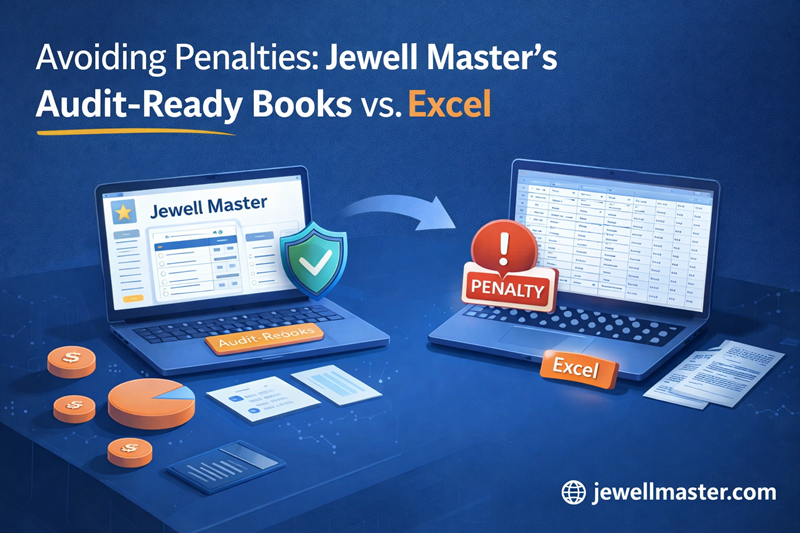
What Is Audit-Ready Books
Audit-ready books refer to financial records that are
structured, transparent, and easily verifiable by auditors or regulatory
authorities. These records must include complete transaction details, accurate
tax calculations, and traceable documentation for every financial activity.
When books are audit-ready, businesses can quickly produce supporting documents
such as invoices, purchase records, and stock reports during compliance checks.
Structured accounting systems automatically maintain these records, ensuring
that financial data remains consistent and organized. Audit-ready books
therefore reduce the time and stress associated with regulatory reviews while
improving financial transparency for business owners and stakeholders.
How Jewell Master Creates Audit-Ready Financial Records
Jewell Master is designed specifically for jewellery
retailers who require precise accounting and compliance management. Unlike
Excel spreadsheets, the platform integrates billing, inventory management, and
accounting into a single structured system. Every transaction recorded within
the software automatically updates financial records and inventory data
simultaneously. Because the system captures transaction details at the time of
billing, it eliminates the need for manual data transfers between systems. This
automated workflow ensures that financial records remain consistent and
accurate. Jewell Master also stores all transaction data in secure digital
databases, allowing businesses to maintain organized and easily accessible
financial documentation.
Automatic Record Creation During Every Transaction
One of the key advantages of using Jewell Master is the
automatic creation of financial records during each transaction. When a
jewellery item is billed, the system records detailed information including
product weight, gold rate, making charges, tax values, and total invoice
amount. These details are instantly reflected in accounting books, inventory
records, and tax reports. Because all data is generated directly from
transactions, the risk of missing entries or calculation errors is
significantly reduced. This automated process ensures that financial records
remain aligned with operational activities, which is essential for maintaining
audit-ready books.
Maintaining a Complete Digital Audit Trail
A major challenge with spreadsheet-based accounting is the
absence of audit trails. In Excel systems, it is difficult to track who
modified a particular entry or when changes were made. Jewell Master solves
this problem by maintaining a complete digital audit trail for all activities
within the system. Every modification to invoices, stock records, or financial
data is recorded with timestamps and user identification. This transparency
provides auditors with a clear record of financial activity and ensures accountability
within the organization. By maintaining detailed audit trails, the system
strengthens compliance and improves trust in financial records.
Real-Time Financial Reporting for Compliance Monitoring
Jewell Master provides real-time reporting tools that allow
jewellery retailers to monitor financial performance and compliance status at
any time. Instead of waiting until the end of the month to reconcile
spreadsheets, business owners can access up-to-date financial reports directly
from the system dashboard. These reports provide insights into sales
transactions, inventory valuation, tax liabilities, and profit margins. Because
the data is generated automatically from system records, the reports remain accurate
and consistent with underlying transaction data. Real-time reporting enables
businesses to identify discrepancies quickly and resolve issues before they
escalate into compliance problems.
Comparing Excel Accounting with Jewell Master ERP
|
Feature |
Excel
Spreadsheets |
Jewell
Master ERP |
|
Data Entry |
Manual input |
Automated
transaction records |
|
Audit Trail |
Not available |
Complete
activity tracking |
|
GST
Compliance |
Manual
calculations |
Automated tax
management |
|
Data
Consistency |
Risk of
errors |
Integrated
system accuracy |
|
Difficult |
Centralized
cloud platform |
Simplifying Multi-Branch Accounting
Jewellery businesses operating multiple showrooms often face
significant challenges when managing financial records across branches. When
each location maintains separate spreadsheets, consolidating financial data
becomes complex and time-consuming. Jewell Master simplifies this process by
connecting all branches through a centralized cloud platform where transactions
are synchronized automatically. Sales recorded at any branch instantly update
the central database, ensuring that accounting books reflect real-time business
activity. This centralized system allows management teams to generate
consolidated financial reports and maintain consistent compliance practices
across all locations.
Reducing Compliance Stress During Audits
Audits can be stressful for businesses that rely on manual
bookkeeping methods because locating supporting documents and verifying records
often takes significant time. Jewell Master reduces this stress by maintaining
structured digital records of every transaction and financial entry. Auditors
can easily review invoices, inventory records, and financial reports within the
system without requiring physical documentation. Because the data is
automatically organized and linked to transaction records, businesses can
provide accurate information quickly during compliance reviews. This efficiency
reduces audit preparation time and minimizes the risk of penalties caused by
missing documentation.
Future-Proof Accounting for Jewellery Retailers
The jewellery retail industry is rapidly adopting digital
technologies to improve operational efficiency and regulatory compliance. As
compliance standards become stricter and digital reporting requirements
increase, spreadsheet-based accounting systems will struggle to meet these
demands. Jewell Master represents a future-ready approach to jewellery business
management by combining accounting automation, inventory tracking, and tax
compliance within a single ERP platform. Businesses that adopt integrated systems
will be better equipped to handle regulatory changes and operational growth
without compromising data accuracy or compliance reliability.
Conclusion
Relying on Excel spreadsheets for jewellery accounting may seem convenient in the short term, but it exposes businesses to significant compliance risks and operational inefficiencies. Manual entries, broken formulas, and lack of audit trails make spreadsheet systems unreliable for maintaining accurate financial records. Jewell Master eliminates these challenges by providing structured audit-ready books that automatically capture transaction data, maintain digital records, and generate compliance reports. By replacing spreadsheets with an integrated jewellery ERP platform, businesses can reduce the risk of penalties, simplify audits, and gain greater visibility into their financial operations. In 2026, adopting audit-ready digital systems like Jewell Master is not just an operational improvement but a strategic necessity for jewellery retailers seeking sustainable growth.