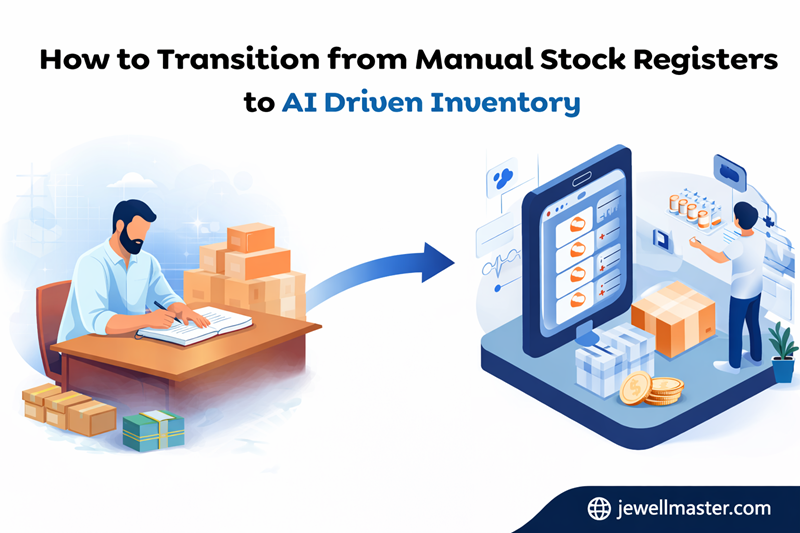
Introduction
Why Manual Stock Registers Are No Longer Sustainable
Manual stock registers were once the backbone of jewellery
inventory management, but modern retail operations demand far greater accuracy
and efficiency. Jewellery stores handle high-value products where even small
inventory discrepancies can result in significant financial losses. Handwritten
registers and spreadsheets often create delays in stock updates and make it
difficult to track individual jewellery pieces accurately. During busy sales
periods, staff may forget to record transactions immediately, resulting in
mismatched stock records. Manual systems also make it difficult to generate
reports, monitor product performance, or track stock movement across branches.
As jewellery businesses grow and expand to multiple locations, the complexity
of inventory management increases significantly. AI-driven inventory systems
like Jewell Master eliminate these challenges by automating stock tracking,
updating inventory in real time, and providing intelligent insights that help
retailers make better operational decisions.
Common Problems with Manual Inventory Systems
Jewellery retailers relying on manual registers frequently
encounter operational challenges that slow down business growth and increase
the risk of financial discrepancies. One of the most common problems is
inaccurate stock recording caused by human error. Employees may forget to
update entries or record incorrect product details, leading to mismatches
between physical stock and recorded inventory. Another major challenge is the
lack of real-time visibility into inventory levels. Store managers cannot instantly
check stock availability or monitor sales performance across branches. Manual
systems also make auditing extremely time-consuming because staff must verify
each register entry individually. In addition, analyzing product demand trends
or identifying fast-selling jewellery items becomes almost impossible without
digital reporting tools. AI-driven inventory systems address all these issues
by maintaining accurate digital records and generating automated reports that
provide deeper business insights.
Step 1: Digitizing Existing Jewellery Inventory Data
The first step in transitioning from manual registers to
AI-driven inventory is converting existing stock records into a digital
database. This process involves entering product details such as jewellery
type, weight, design code, gemstone details, and pricing information into the
inventory system. Although the initial data entry process requires effort, it
forms the foundation of a structured inventory management system. Jewell Master
simplifies this step by allowing jewellers to import stock data through structured
templates and barcode integration. Once the data is digitized, store managers
can instantly search for products, track inventory levels, and generate
reports. Digitizing stock records also reduces the risk of data loss and makes
it easier to maintain accurate historical records of inventory transactions.
Step 2: Assigning Unique Product Identification
After digitizing stock records, the next step is assigning
unique identification numbers to each jewellery item. Unique product IDs allow retailers to track individual pieces accurately across sales, returns, and
transfers between branches. Jewell Master supports serialized inventory
tracking, enabling jewellers to assign unique codes to every jewellery item in
the inventory. This ensures that each piece can be tracked throughout its
lifecycle, from procurement to sale. Unique identification also simplifies
stock verification processes and reduces the chances of product misplacement.
When staff scan the product ID during billing or stock audits, the system
automatically retrieves product details, ensuring accurate inventory tracking.
Step 3: Implementing Real-Time Inventory Updates
One of the most powerful benefits of AI-driven inventory
systems is real-time stock synchronization. In manual systems, stock records
are updated only after transactions are recorded in registers, which often
leads to delays and inaccuracies. Jewell Master automatically updates inventory
whenever a product is sold, returned, exchanged, or transferred between
branches. This real-time synchronization ensures that store managers always
have accurate information about available stock. Real-time inventory visibility
also improves customer service because sales staff can instantly check product
availability and provide accurate information to customers.
Step 4: Integrating Billing with Inventory Management
Manual inventory systems often operate separately from
billing systems, which creates inconsistencies between sales records and stock
data. AI-driven inventory systems eliminate this disconnect by integrating
billing with stock management. Jewell Master automatically deducts sold items
from inventory during billing and updates stock records instantly. This
integration prevents inventory mismatches and ensures accurate financial
reporting. Because billing and inventory updates occur simultaneously, jewellery retailers can maintain consistent records without performing manual
reconciliations at the end of the day.
Step 5: Leveraging AI-Driven Insights for Better Decisions
Once the inventory system is fully digitized, jewellers can
begin using AI-powered analytics to gain deeper insights into business
performance. Jewell Master analyzes sales data, inventory turnover rates, and
product demand patterns to help retailers make smarter purchasing decisions.
AI-driven insights can identify best-selling jewellery designs, detect
slow-moving inventory, and recommend optimal stock levels. These insights
enable jewellers to optimize inventory investments and improve profitability.
Instead of relying on guesswork or manual calculations, store owners can make
data-driven decisions supported by intelligent reporting tools.
Key Benefits of AI-Driven Inventory Systems
• Real-time inventory tracking
• Automated stock updates during billing
• Accurate tracking of individual jewellery items
• Advanced analytics and reporting
• Reduced inventory discrepancies
• Faster stock audits and verification
• Improved operational efficiency
Manual Inventory vs AI Driven Inventory Systems
|
Feature |
Manual
Registers |
AI Driven
Inventory |
|
Stock Updates |
Delayed |
Real-time |
|
Error Risk |
High |
Very low |
|
Product
Tracking |
Difficult |
Serialized
tracking |
|
Reporting |
Limited |
Advanced
analytics |
|
Complex |
Centralized
control |
|
|
Audit Process |
Time
consuming |
Automated
reporting |
Why Jewell Master Makes the Transition Easy
Transitioning from manual registers to AI-driven inventory
may seem complex at first, but the right software makes the process simple and
efficient. Jewell Master is specifically designed for jewellery businesses,
which means it understands the unique challenges of tracking gold, diamonds,
and gemstone jewellery. The system provides structured tools for inventory
digitization, barcode integration, serialized tracking, and automated
reporting. Jewellery retailers can gradually migrate their existing records into
the system without disrupting daily operations. The cloud-based architecture of
Jewell Master also ensures that inventory data is securely stored and
accessible from any location, making it ideal for multi-branch jewellery stores.
Conclusion
Transitioning from manual stock registers to AI-driven inventory management is a crucial step for modern jewellery businesses aiming to improve operational efficiency and accuracy. Manual systems struggle to keep up with the complexities of high-value jewellery inventory, often resulting in errors and inefficiencies. Jewell Master simplifies this transition by providing automated inventory tracking, real-time updates, and intelligent analytics. By adopting AI-driven inventory systems, jewellery retailers can eliminate stock discrepancies, improve decision-making, and create a more scalable and efficient retail operation.
