Introduction
Why Manufacturing Billing Is Important in Jewellery Businesses
Jewellery businesses often combine retail operations with
in-house manufacturing or job work services. When customers request custom
jewellery pieces or when retailers manufacture designs internally, the billing
structure becomes more complex than standard retail transactions. Instead of
simply billing for finished products, manufacturers must account for labour
costs, making charges, raw material usage, and design complexity. These factors
influence the final price of the jewellery item and must be calculated
accurately. If manufacturing costs are not recorded properly, businesses may
underprice products or lose track of production expenses. Proper manufacturing
billing therefore ensures that jewellery businesses maintain profitability
while providing transparent pricing for customers.
Understanding Labour and Making Charges in Jewellery
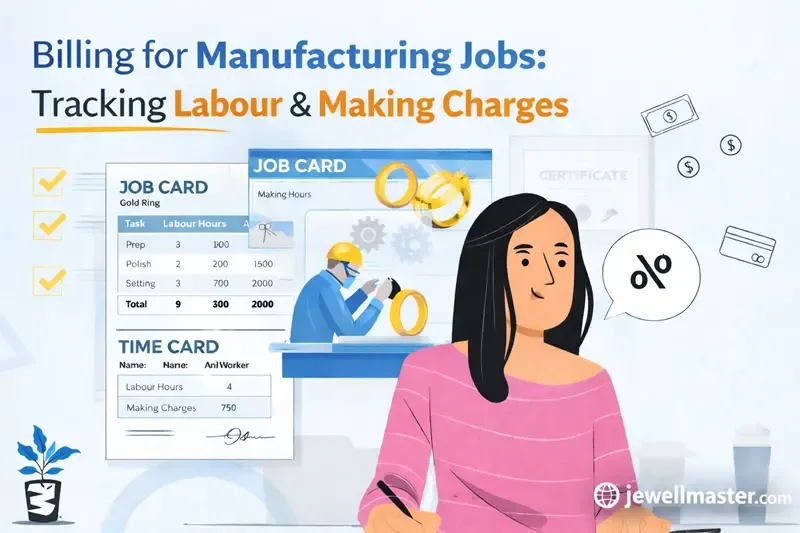
Making charges represent the labour cost involved in
transforming raw materials such as gold or silver into finished jewellery
designs. These charges vary depending on the complexity of the design,
craftsmanship required, and time spent during production. In many cases,
jewellers calculate making charges either as a percentage of the gold value or
as a fixed cost per gram of metal used. Labour costs may also include
additional expenses such as polishing, stone setting, engraving, or finishing
work. Because these charges differ from one jewellery item to another, billing
systems must be capable of capturing these details accurately during invoice
preparation.
Components of Jewellery Manufacturing Cost
|
Cost
Component |
Description |
|
Gold / Silver
Weight |
Raw metal
used for production |
|
Gemstones |
Stones used
in jewellery design |
|
Labour
Charges |
Craftsman
wages for production |
|
Making
Charges |
Cost of
design and craftsmanship |
|
Finishing
Work |
Polishing and
final adjustments |
Challenges of Manual Manufacturing Billing
Many jewellery manufacturers still calculate labour and
making charges manually using spreadsheets or handwritten production records.
In such systems, staff members must track raw material consumption, labour
hours, and design specifications separately before preparing invoices. This
fragmented process often leads to inconsistencies between production records
and billing documents. For example, if labour costs are recorded incorrectly or
omitted from invoices, the final product may be sold below its actual manufacturing
cost. Manual processes also make it difficult to analyze production efficiency
or track the profitability of specific designs. Without an integrated system,
managing manufacturing billing becomes both time-consuming and error-prone.
Why Generic Billing Software Cannot Handle Manufacturing Jobs
Generic billing software is typically designed for
straightforward retail transactions where products are purchased and sold
without additional production processes. These systems often lack the ability
to track manufacturing activities such as raw material consumption, labour
costs, and production stages. When jewellery businesses attempt to manage
manufacturing jobs using such software, they must rely on external spreadsheets
or manual records to calculate production costs. This separation between production
tracking and billing systems creates data inconsistencies and increases
administrative workload. Jewellery manufacturers require specialized systems
that integrate production data directly with billing processes.
How Jewell Master Supports Manufacturing Billing
Jewell Master is designed to handle the unique requirements
of jewellery manufacturing by integrating production tracking with billing
operations. The system allows jewellers to record manufacturing jobs that
include details such as raw materials used, labour costs, and design
specifications. When a jewellery item is completed, the platform automatically
calculates the total manufacturing cost by combining material value and labour
charges. This integrated workflow ensures that invoices reflect the true cost
of production while maintaining accurate financial records. By linking
production data with billing systems, Jewell Master eliminates the need for
manual cost calculations.
Tracking Labour Costs in Production Jobs
Labour tracking is essential for jewellery manufacturers
because craftsmanship plays a major role in determining the value of finished
products. Jewell Master allows businesses to record labour costs associated
with each manufacturing job. These records may include craftsman wages, design
work, and specialized processes such as stone setting or engraving. By
capturing labour details within the system, businesses can ensure that
production expenses are included in the final invoice. This structured tracking
helps jewellery manufacturers understand the true cost of craftsmanship and
maintain consistent pricing strategies.
Automatic Calculation of Making Charges
Making charges are one of the most important components of jewellery pricing because they represent the cost of transforming raw materials
into finished ornaments. Jewell Master allows jewellers to define making charge
rules based on weight, percentage, or fixed values. When a jewellery item is
billed, the system automatically applies the appropriate making charge
calculation based on these predefined rules. This automation ensures
consistency in pricing and prevents errors that may occur during manual calculations.
Because the system performs these calculations automatically, staff members can
generate accurate invoices quickly without needing complex manual formulas.
Recording Raw Material Consumption
Jewellery manufacturing requires precise tracking of raw
materials such as gold, silver, and gemstones. If raw material consumption is
not recorded correctly, inventory records may become inaccurate and production
costs may be misrepresented. Jewell Master tracks raw material usage during
manufacturing jobs and updates inventory records automatically when materials
are consumed. This capability ensures that stock levels reflect actual
production activity while maintaining accurate records for financial reporting
and inventory management.
Comparing Manual Manufacturing Billing with Jewell Master
|
Feature |
Manual
System |
Jewell
Master ERP |
|
Labour
Tracking |
Separate
records |
Integrated
with production jobs |
|
Making Charge
Calculation |
Manual
formulas |
Automatic
system rules |
|
Raw Material
Tracking |
Manual
updates |
Automatic
inventory adjustment |
|
Invoice
Accuracy |
Risk of
missing costs |
Accurate
production billing |
|
Production
Analysis |
Limited
visibility |
Detailed
manufacturing reports |
Managing Custom Jewellery Orders Efficiently
Custom jewellery orders require careful coordination between
design teams, craftsmen, and billing departments. Customers often request
personalized designs that involve specific gemstones, unique shapes, or special
engraving work. Jewell Master allows jewellers to record these custom
manufacturing jobs within the system, ensuring that all production details are
captured before the final invoice is generated. This structured approach
ensures that labour costs, material usage, and additional design charges are
included in the final billing value. By managing custom orders through the
system, jewellery businesses can maintain transparency and avoid under-pricing
complex designs.
Improving Production Profitability Analysis
Tracking manufacturing costs accurately allows jewellery
businesses to analyze the profitability of their production activities. Jewell
Master provides reporting tools that allow business owners to review labour
expenses, material costs, and overall production efficiency. These insights
help jewellers identify which designs generate the highest profit margins and
which production processes may require optimization. By analyzing manufacturing
data alongside sales performance, businesses can make informed decisions about
pricing strategies and product development.
Simplifying Coordination Between Production and Sales Teams
In jewellery businesses where manufacturing and retail
operations coexist, coordination between production teams and sales staff is
essential. Jewell Master helps bridge this gap by connecting manufacturing job
records with billing and inventory systems. When a production job is completed,
the finished jewellery item becomes available in inventory and can be billed
directly through the sales module. This integration ensures that production
data flows seamlessly into retail operations without requiring manual updates
or duplicate records.
Conclusion
Jewellery manufacturing involves multiple cost components such as labour, making charges, and raw material consumption, making billing more complex than standard retail transactions. Manual calculation methods often lead to pricing mistakes, inventory discrepancies, and inaccurate financial records. Jewell Master simplifies manufacturing billing by integrating production tracking with billing and inventory management within a unified ERP system. By automatically calculating labour costs, making charges, and material usage, the platform ensures that invoices reflect the true cost of production. With Jewell Master, jewellery manufacturers can maintain accurate billing records, improve production transparency, and ensure profitable operations.
