Introduction
Why Jewellery Businesses Manage Both Retail and Wholesale Sales
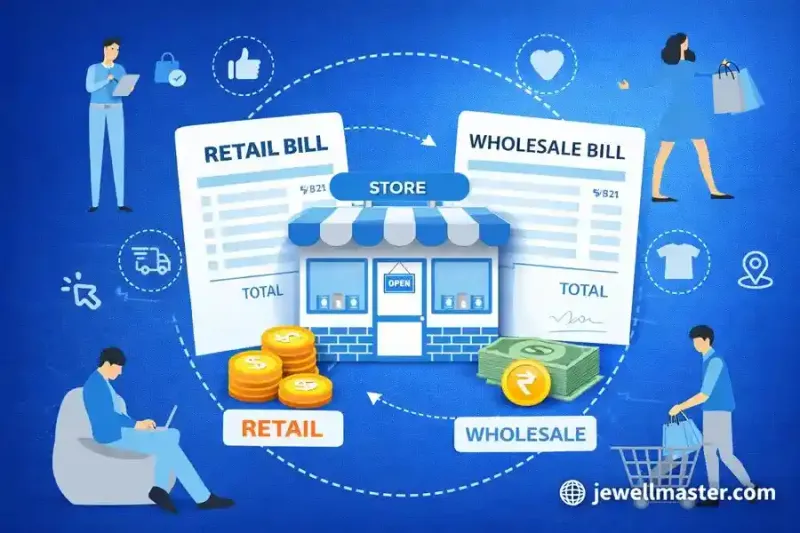
Many jewellery retailers operate hybrid business models
where they sell products directly to customers through showrooms while also
supplying jewellery to other retailers or distributors. Retail transactions
typically involve individual customers purchasing jewellery pieces for personal
use, whereas wholesale transactions involve bulk orders from jewellery shops,
traders, or export buyers. These two business models require different pricing
structures, billing formats, and accounting practices. Retail sales focus on
individual product pricing and customer billing, while wholesale transactions
often involve negotiated rates, bulk discounts, and business-to-business
invoicing. Managing these operations efficiently requires a billing system
capable of handling both sales models without creating operational complexity.
Key Differences Between Retail and Wholesale Jewellery Billing
Retail and wholesale billing processes differ significantly
because the nature of transactions and pricing structures vary. Retail sales
usually involve fixed pricing based on weight, purity, and making charges,
while wholesale orders may include negotiated pricing or bulk discounts
depending on order quantity. Wholesale clients often require detailed invoices
that include product specifications, tax details, and payment terms. Retail
billing, on the other hand, focuses on quick checkout processes and transparent pricing for customers. If these two billing workflows are managed through
separate systems, businesses may face inconsistencies in pricing records, tax
calculations, and inventory tracking. An integrated billing solution helps
eliminate these operational gaps.
Retail vs Wholesale Jewellery Sales Comparison
|
Factor |
Retail
Sales |
Wholesale
Sales |
|
Customer Type |
Individual
buyers |
Businesses
and traders |
|
Order Size |
Single items |
Bulk
quantities |
|
Pricing
Structure |
Fixed retail
pricing |
Negotiated
bulk pricing |
|
Payment Terms |
Immediate
payment |
Credit or
business terms |
|
Invoice
Format |
Customer-focused |
Detailed B2B
documentation |
Problems with Using Separate Systems for Retail and Wholesale
When jewellery businesses manage retail and wholesale
billing through different systems, operational inefficiencies often arise.
Separate systems may maintain different product records, pricing
configurations, and tax settings, which can lead to inconsistencies in
financial data. Inventory management also becomes difficult because stock
levels must be updated separately for each system. If wholesale sales are not
synchronized with retail inventory records, businesses may unknowingly sell
products that are already allocated to bulk buyers. Maintaining separate
billing platforms also complicates accounting processes because financial data
must be consolidated manually. These challenges increase administrative
workload and raise the risk of errors.
Why Generic POS Systems Cannot Handle Wholesale Operations
Generic point-of-sale systems are designed primarily for
retail transactions where customers pay immediately and receive the product at
the time of purchase. These systems typically lack features required for
wholesale operations such as bulk pricing management, credit terms, and
detailed product specifications. When jewellery businesses attempt to manage
wholesale orders through retail POS systems, they must rely on external
spreadsheets or accounting tools to track bulk orders and payment schedules. This
fragmented workflow creates inconsistencies between billing records and
inventory data. Without integrated wholesale management capabilities, generic
POS systems cannot provide the flexibility required for jewellery businesses
operating across multiple sales channels.
How Jewell Master Integrates Retail and Wholesale Billing
Jewell Master is designed specifically for jewellery
businesses that manage both retail and wholesale operations. The platform
allows businesses to handle both types of transactions within a single
integrated system. Retail sales can be processed quickly through standard
billing workflows, while wholesale transactions can be configured with custom
pricing structures and detailed invoice formats. Because both billing types
operate within the same platform, inventory records remain synchronized
automatically. This integration ensures that stock levels update instantly
regardless of whether a product is sold through retail channels or wholesale
orders.
Flexible Pricing for Different Customer Categories
Pricing flexibility is essential for jewellery businesses
that serve both retail customers and wholesale buyers. Retail customers
typically purchase products at standard showroom prices, while wholesale
clients often receive discounted rates based on volume or long-term business
relationships. Jewell Master allows jewellers to create different pricing
structures for different customer categories. When billing a transaction, the
system automatically applies the appropriate pricing configuration based on the
selected customer type. This feature ensures that retail customers receive
consistent pricing while wholesale buyers benefit from negotiated rates without
requiring manual adjustments during billing.
Managing Bulk Orders Efficiently
Wholesale transactions often involve large quantities of
jewellery items or raw materials, making order management more complex than
standard retail billing. Jewell Master provides tools for managing bulk orders
efficiently by allowing jewellers to create detailed order records that include
product specifications, quantities, and negotiated pricing. Once a wholesale
order is confirmed, the system reserves the required inventory and prepares the
billing documentation accordingly. This structured workflow helps businesses
track bulk transactions clearly while ensuring that inventory allocation
remains accurate.
Synchronizing Inventory Across Retail and Wholesale Channels
Inventory synchronization is one of the most important
advantages of combining retail and wholesale billing within a single system.
When businesses use separate platforms for these operations, stock levels may
become inconsistent because updates are not reflected across systems
immediately. Jewell Master solves this problem by maintaining a centralized
inventory database that updates automatically whenever a sale occurs. Whether a
jewellery item is sold through a showroom counter or through a wholesale order,
the system adjusts inventory records instantly. This real-time synchronization
ensures that businesses always have accurate stock visibility.
Comparing Separate Billing Systems with Jewell Master
|
Feature |
Separate
Systems |
Jewell
Master ERP |
|
Billing
Workflow |
Multiple
systems |
Unified
platform |
|
Inventory
Tracking |
Risk of
mismatches |
Real-time
synchronization |
|
Pricing
Management |
Manual
adjustments |
Automated
customer-based pricing |
|
Accounting
Integration |
Manual
consolidation |
Integrated
financial records |
|
Operational
Efficiency |
Complex
workflows |
Simplified
operations |
Improving Financial Reporting Across Sales Channels
When retail and wholesale transactions are managed within
the same system, financial reporting becomes significantly easier. Jewell
Master automatically records sales data from both channels in the accounting
module, allowing businesses to generate consolidated financial reports.
Business owners can analyze revenue generated from retail customers and
wholesale buyers separately while maintaining a unified financial overview.
This visibility helps jewellery retailers understand which sales channel contributes
more to profitability and enables better strategic decision-making.
Enhancing Customer Relationship Management
Serving both retail and wholesale clients requires
maintaining strong relationships with different types of customers. Retail
customers expect personalized service and transparent pricing, while wholesale
buyers require efficient order processing and reliable delivery schedules.
Jewell Master helps jewellers manage these relationships by maintaining
detailed customer records within the system. Retail customer purchase histories
and wholesale buyer transaction records are stored in the same platform, allowing
businesses to track interactions and tailor their services accordingly. This
unified customer management approach improves operational efficiency and
customer satisfaction.
Preparing Jewellery Businesses for Multi-Channel Growth
The jewellery industry is evolving rapidly with businesses
expanding into new sales channels such as online marketplaces, export
operations, and wholesale distribution networks. Managing these channels
effectively requires flexible billing systems capable of adapting to different
transaction types. Jewell Master supports this multi-channel growth by
providing an integrated platform that handles retail billing, wholesale
transactions, and inventory management simultaneously. This capability allows jewellery retailers to scale their operations without needing multiple software
systems.
Conclusion
Jewellery businesses that operate both retail showrooms and wholesale supply channels require billing systems capable of managing different transaction types efficiently. Using separate systems for retail and wholesale operations often leads to inventory mismatches, inconsistent pricing, and complicated accounting processes. Jewell Master solves these challenges by integrating both billing workflows within a single platform that synchronizes inventory, automates pricing structures, and simplifies financial reporting. By combining retail and wholesale billing in one system, jewellery retailers can streamline operations, improve accuracy, and maintain better control over their business performance across multiple sales channels.
